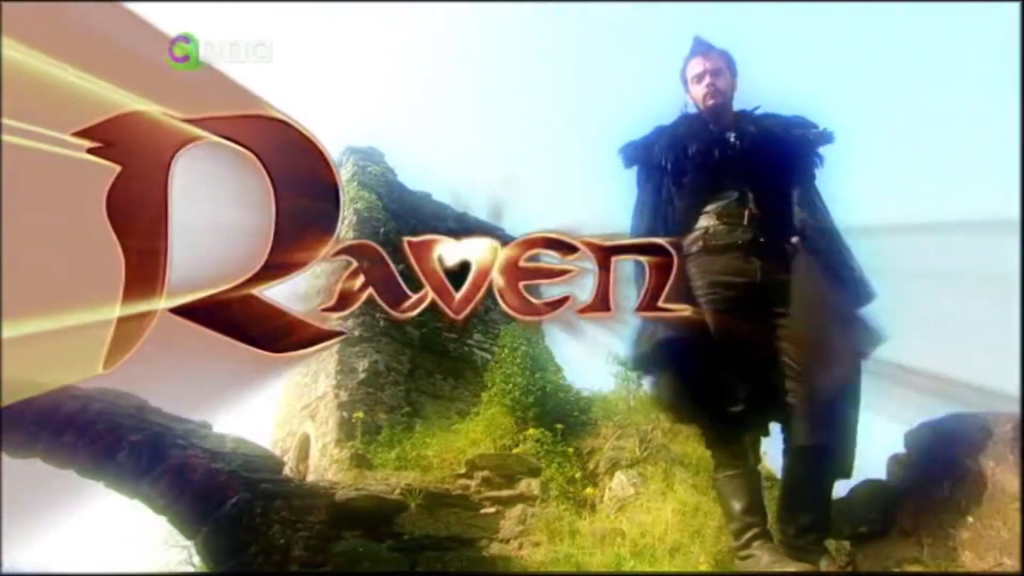
Raven Season 5: Challenge Rankings – Part 1


              Raven was always the show I most wanted to watch on TV as a child, and it hasn’t sunk down in the rankings of my favourite shows as much as it, perhaps, should have as I have gotten older. That is not to imply the show is bad, far from it, but I cannot deny the decidedly pink hue that appears through my glasses when I think back on it.

               Raven is about a group of children, or Warriors as the show calls them, competing to be named the ‘Ultimate Warrior’, a title which was the envy of every school-child in the mid-noughties, and would be a fun titbit to add on the end of any CV nowadays. I know if I ever saw someone who’d won Raven come to an interview I’d be hard-pressed not to offer them a job on the spot. In order to gain this coveted title, the Warriors were guided through different challenges that they had to compete by Raven himself, a mysterious figure with vast magical powers who also wore a cool cloak and had a nice Scottish accent. The challenges are what took up most of the show’s runtime, and what most people will remember about the show, perhaps with the exception of some exceptional set and costume design, or the charisma of the host.

I find it hard to believe that anyone reading this won’t have seen Raven when they were younger, otherwise I wonder how on earth you ended up here, don’t you have better things to do? For example, watching season 5 of Raven? But, just to refresh your memories, here’s a reminder of how the show was structured. Each warrior starts off with nine lives, the warriors lose lives if they lose a challenge, and has the potential to gain rings if they win a challenge. Gain nine rings and you gain back a life. Lose all your lives and you’re out. If you have the least lives and rings at the end of an episode, you must take on ‘The Way of the Warrior’ gauntlet, which if you fail, you go home. There were three rounds of heats, two Warriors from each heat going through to the final week, where they compete to be crowned the sole winner. So simple even a child could understand!

This article is going to discuss all the 26 challenges that appeared in season 5 of Raven, ordering them from my most to least favourite. Often in these articles, the biggest interest in reading comes from the suspense in what the results might be, to see what red-hot and ice-cold takes the writer could have. But, honestly, I think it would be remiss of me to try and pretend that anything other than ‘Way of the Warrior’ is coming in first in this ranking, because it’s genuinely as good as you remember it being, and a clear highlight of the show. But I believe the points I’m going to make here are interesting enough that reading through them will be worthwhile anyway.

This is a show that I used to love, and even though I’d forgotten a lot about it before I sat down and rewatched it, I still thoroughly enjoyed it. And I hope, by writing this, I might be able to remind you of why you used to like it so much as well.

26 – Serpent’s Eye
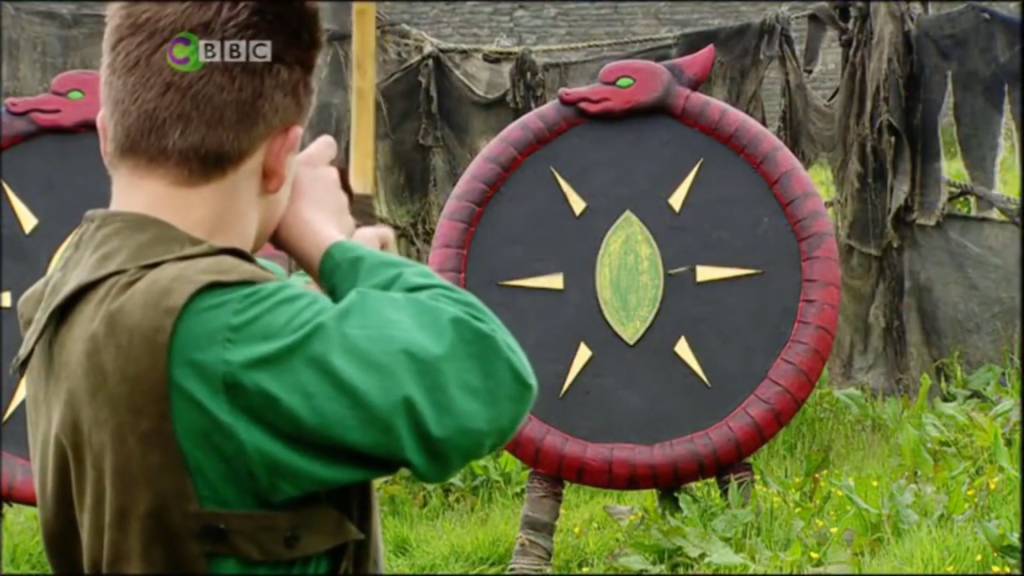
I don’t think any challenge in Raven (at least in season 5) is bad, but if I was forced to remove one challenge from the season, it would be this one. Serpent’s eye (or as most people would call it, archery) is, effectively, a test of whether the Warrior has ever held a bow and arrow before. And seemingly, based on the level of skill on display, one which most would fail.

The Warriors, taking it in turns, are given three arrows and a bow which they much use to hit targets with an oversized bullseye and a snake around the edge. The target must be hit at least once to prevent losing a life, and for each arrow that hits the bullseye a ring is gained. However if the snake around the target were hit, the Warrior loses automatically. Exciting, right? That was rhetorical, it is about as unexciting as you can get in Raven, but that’s a decently high bar.

Seemingly no skill is involved in this challenge as the bows used appear to be made of string and cardboard, and with the amount of wind sometimes present, the whole challenge just comes across as a crapshoot. This idea id reinforced by the fact that the Warriors who competed in the challenge multiple times keep no consistency in their performance.

Additionally, the challenge is far too long for what it is; seeing 15 arrows fired in succession (as this is usually done on the third day, when only five contestants remain) is not in any way exciting. This challenge is improved by such a margin when people go out before they have used all their arrows it is unbelievable, the amount of time saved is immense. But that only goes to show how long and uninteresting the challenge usually is.

I also find it hard to enjoy any challenge that the Warriors play so sub-optimally. After the target has been hit successfully, in my mind you should always then aim to miss. Intuitively, I believed, that the chances of you gaining a ring were dwarfed by the chances of you going out instead. Luckily, after extensive research, I managed to find the statistics which back my point up! After successfully hitting the target, if the Warrior continued to fire the arrows aiming for the target every time (which the Warriors always did, because they were playing within the spirit of the game as opposed to gaming the system on a children’s TV show, like idiots) 13% gained a ring subsequently, 53% saw no change, and a whopping 33% lost a life. (Yes, I know that those percentages only add up to 99%, but I’m sure you guys can figure how rounding errors work, get off my back!) And to me at least, going for a 13% chance of improving your standing is not worth the 33% risk of losing a life which would otherwise be preserved. Basically, what I’m trying to say is that I would beat these children at Serpent’s eye, easily.

As a final insult, however, and the main reason this is at the bottom of the list, as opposed to higher, is that in the final week of the season, they decided to do the challenge twice instead of once, removing two other better challenges to fit it in. Worse, they did this in the season finale! This made me genuinely annoyed, which means my priorities are totally out of whack, but more importantly that the series finale started on a dour note, and it is entirely because of Serpent’s Eye that this happened.

That’s not to say the challenge is all bad. Having done archery in real life (making it one of the few challenges on Raven I have actual experience of) I can say that the Warriors probably had a lot of fun doing it, but that, unfortunately, doesn’t always translate to good TV. And, as with most of the Raven challenges, the set design cannot be faulted. The real highlight of the challenge, though, comes outside of the challenge itself. The challenge is initially demonstrated by Raven himself, showing how he can hit the perfect bullseye of the target without looking. And yes, it’s obviously just editing trickery, but that only makes the faux impressed faces the Warriors make after pretending to watch him do it all the better. And if that isn’t the magic of television, I don’t know what is.

25 – Burning Battlements
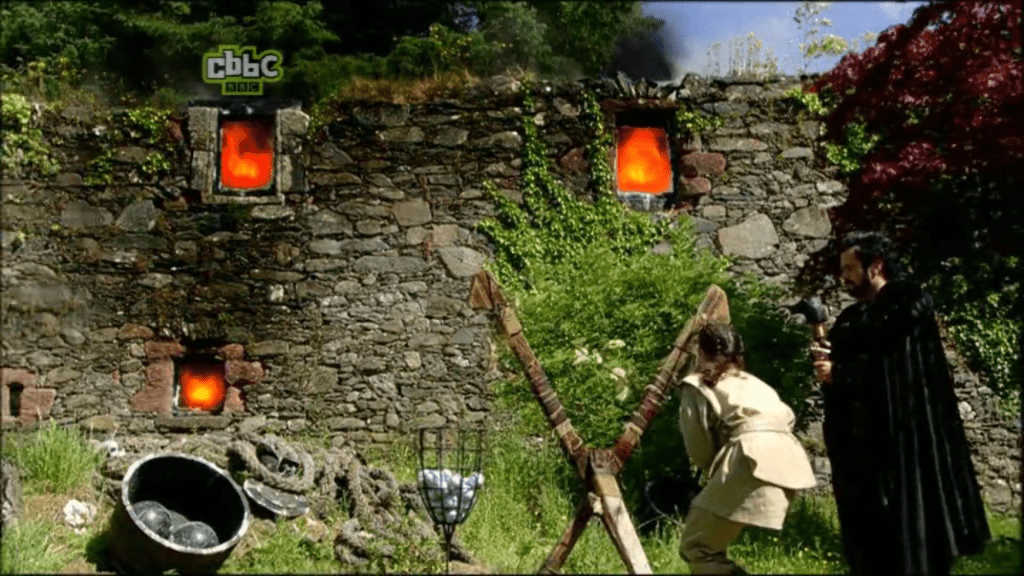
Well, two down on the list, and both of the ‘children use a piece of equipment to hit a target’ challenges have already fallen. What can I say? I know what I like, and watching children try to hit targets apparently ain’t it.

The Warriors take it in turns to put out three magical fires using a supply of ice balls before the flames consume them, i.e. contestants use a catapult to fire balls through holes in a wall within a given time limit. Warriors gain rings equal to the number of fires they extinguish, and lose a life if no fires were extinguished within the time limit.

There are a few positives with the challenge. The fire animations, while decent for the time, don’t really hold up nowadays, and the smoke effects aren’t much better, but there’s a certain charm to them that I can’t help but like. And the sound effect when the fires go out is extremely satisfying. The background music is also decent too, I guess. Unfortunately, that is where the positives end.

There are a multitude of problems with Burning Battlements which is why it falls so close to the bottom of this list. It is a challenge which drags on for far too long, even longer then Serpent’s Eye does, and that’s saying something. Watching four Warriors attempt the same challenge in the same way four times in a row usually isn’t interesting, but often the challenges are fun in of themselves to make up for it, unfortunately that is not the case here.

Another annoyance, and one which is a particular problem in this challenge, is the inconsistency in the explanation. It is only occasionally mentioned, mid challenge, that there is a time limit in place here. This is a bad explanation for people watching, as another natural assumption could be that the challenge ends when you are out of balls, as opposed to out of time. This is doubly annoying as there is seemingly no reason for the challenge to end when it does, it’s arbitrary. Other challenges may have hourglass timers, or perhaps a slowly opening door by which the time can be judged. Here there is nothing. The challenge seems to start and end by Raven’s whims alone, and he is seemingly a fickle master.

A far pettier gripe is that this is the second easiest challenge of the season, with only one Warrior losing a life on it over the whole season, corresponding to a ~94% success rate. There is nothing wrong with easy challenges though, and these kind of ‘give-me’ challenges are required to stop any of the contestants being eliminated prior to the Way of the Warrior, but it emphasises the biggest problem with this challenge. It’s boring. At least if there were more risk that the warriors could fail it might keep my interest a little more, but alas it does not.

The difference in quality between this and Serpent’s Eye are slight, with both being fairly boring challenges with a few redeeming features. And honestly, it would be a coin flip most days as to which one I enjoy less. But I think the real reason Burning Battlements edges the win is because it did less to actively annoy me than Serpent’s Eye did. And I did still enjoy watching it, but mostly for the little smile that Raven does when they do well, that man could light up any room! Or any rural Scottish ruins, as is usually the case in this show.

24 – Warrior’s Gate
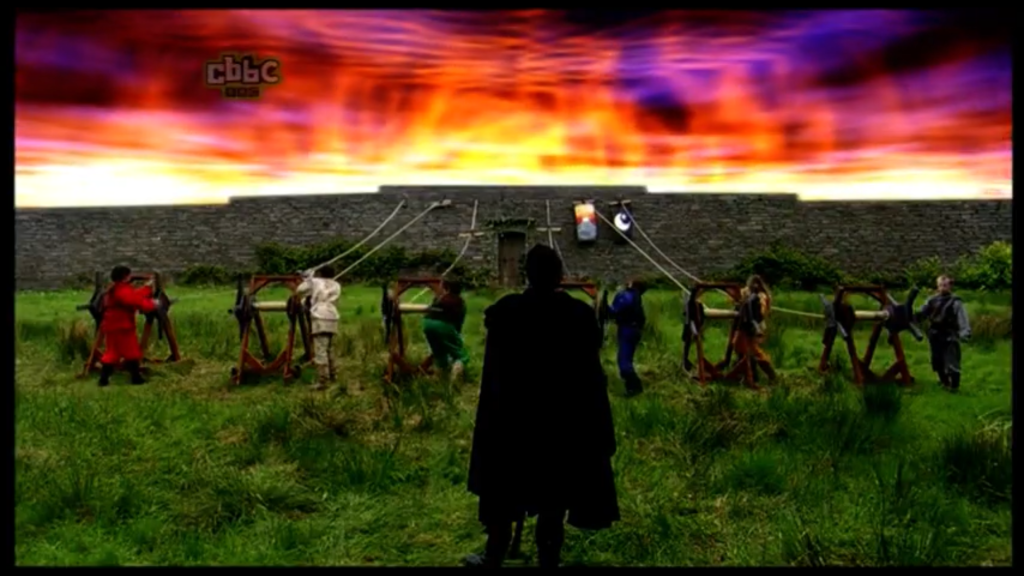
My memory is a remarkable thing, I find myself unable to recall the names of people I’ve known for years, yet ask me to remember random details from the TV shows I watched as a child and I surprise myself with the amount I can remember. Going into season 5 of Raven I was confident I would have memory of a lot of the challenges that appeared on this season, despite probably not having watched it since it first aired in 2006. Exceeding even my expectations, I found that I did actually have clear memories of 25 out of the 26 challenges. I had only forgotten one challenge from this season, the opening challenge of the season in fact, Warrior’s Gate. There was a reason for that.

In order for the Warriors to compete on Raven, they pass through the gate which connected Raven’s Realm to the rest of the known universe. To be allowed to do this the Warriors must first prove their skill to Raven to show they are strong enough to attempt the quest. They do this by putting together a simple winch, and then turning said winch to move a golden scroll towards a wall. Once the scroll reaches the wall the Warrior’s symbol is revealed. The first warrior to finish receives three rings, second gets two rings and third gets one ring. The remaining Warriors receive no rings, but unlike most other challenges in this season, do not lose a life.

My first, and most egregious, problem with this challenge is its explanation in universe. This is the challenge that Raven uses to ensure the Warriors are ready to embark on a deadly quest, facing formidable foes, and even each other. And to test their skills, what does he do? See if they can make the simplest winch in the world and then spin it quicker than some other children. Hell, it doesn’t even have to be quicker than other children, they just have to be able to do it eventually. I wonder if there was a time limit on this. If some poor child were still spinning the winch to this day, could they still be told that this shows the skill they require once the task is completed? I ask you… The fact that Nevar (Raven’s cleverly named arch-nemesis) is never defeated makes a lot of sense with this kind of lackadaisical attitude Raven has to Warrior testing.  A more suitable challenge would be some kind of brutal fight to the death, though that would make Raven just as evil as Nevar; not that Nevar is ever shown to do anything that evil, other than sit around menacingly in a tower, but that’s a real mood tbh, I back it.

Speaking of the challenge itself, and not the strange ramblings I sometimes find myself descending into, there is little to say. It is what it sounds like, Warriors build and then use a winch, it isn’t hugely entertaining or exciting. Due to the angle of the camera shots they chose to use during the challenge, it is near impossible to tell what position the different Warriors are in at any one time. It’s hard to be invested in watching a race when you have no idea how anyone is performing. Even the construction of the winch, which could be an interesting task in of itself, isn’t interesting here as it is too simple to provide any kind of challenge. It seems to serve no purpose, not even to slow the warriors down. The designers of this challenge seemed to choose to do this before debating whether or not they should.

This challenge is also the one used to give each Warrior their icon for the week. These icons serve little purpose in the show other than making the Warriors each week easily recognisable, but they’re very effective. However, before the challenge even begins it is abundantly clear which Warrior will get which symbol, as the symbols are colour coordinated, and all the Warriors have already been given a coloured tunic, meaning there is no intrigue into who will get which symbol. Earlier seasons forego this problem entirely by giving symbols automatically, and later seasons give the Warriors generic tunics prior to earning their symbol, so the fact that it works this way this season is appears as a clear oversite. It’s a minor annoyance, but an annoyance nevertheless.

This is the last of the challenges that I would say I dislike more than I like, so everything after this is a big step up. And, unlike the previous two challenges on this list, Warrior’s Gate is mercifully short, which gives it a real boost over the other two. It’s a bit uninteresting, explaining why I forgot it, but that’s not the end of the world. Not everything has to be fights to the death and fiendish puzzles, but the show might be better if it were, though less likely to be broadcast pre-watershed.

23 – Water Demon
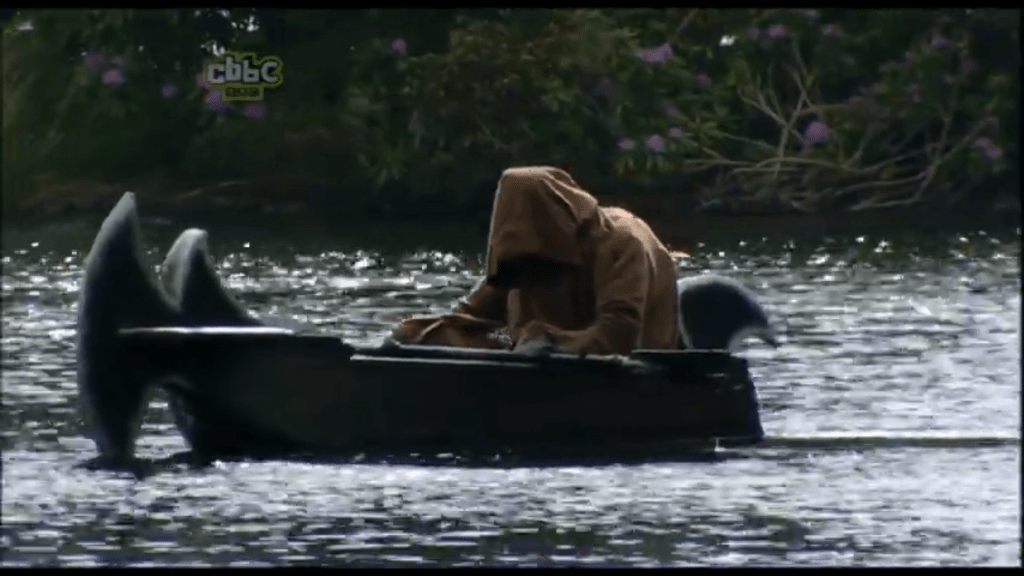
Four entries down on the list and we have our first appearance one of the most easily recognisable features of Raven, the Demons. While simply designed, just being figures in brown hooded robes with their face hidden, it’s a very effective design that has stood the test of time far better than some of the other visual effects the show uses. They appear as a clear and obvious danger, working as an easily identifiable enemy for the warriors to go up against. They are used in about 30% of the challenges in season 5, so remain a consistent presence throughout the season, appearing at least once in every episode. But this good design cannot redeem every challenge that they appear in.

In Water Demon, the Warriors are split into two teams of three, taking it in turn to take on the challenge. In each team two members remain on shore while one grabs rings from a jetty before getting into a round boat (which is apparently called a coracle, so I can now say I have learnt at least one thing from watching Raven as a 25-year-old). The Warrior in the coracle then paddles back to shore while the other two Warriors pull them in with an attached rope. Once the rings have been grabbed, a demon starts slightly behind them in another boat (which looks like a canoe, but has a kayak paddle, so I will call it a kaoe). If the Warriors make it to shore before the Demon’s kaoe touches the coracle, then they win the rings collected. If not, all three lose a life.

I made notes for every challenge this season, and this is the only challenge where I forgot to finish writing them midway because I lost interest and didn’t notice. This is another mostly uninteresting challenge, especially as it is unclear now useful each of the Warriors is to succeeding the challenge, as it appears the further forward of the two pulling in the boat does the brunt of the work, with the second Warrior on shore merely there to prevent the rope getting tangled. The person in the boat also appears to hinder the challenge more often than help with their misguided attempts at paddling slowing them down far more than speeding them up. But watching teams unintentionally self-sabotage is a good laugh, so that’s actually a positive. I don’t know whether what I’ve just said is true, but in the end, it doesn’t matter; in the world of TV, and in much of life itself, what appears to be true is true, and that is the only way that I may judge it.

Water Demon is also a challenge which can easily be gamed, with a correct strategy that should be used, namely that you put the smallest person in the coracle and the strongest remaining as the primary roper puller. But these are children, who don’t have my complex understanding of the ways of the world, or knowledge of how the season turned out after the fact, so I would be better than them at this challenge, and that’s what really matters.

While the idea of the chase may be interesting on paper, it is usually clear who the victor will be long before the challenge has finished. There is only one close bout in all of the times it is seen this season, and even then, it did not make the challenge particularly more interesting to watch. It is also unclear whether the chasing demon is going at a consistent speed between attempts, meaning some groups could have a far easier time of it than others.

However, the visuals in this challenge are very strong. As mentioned previously, the Demon design is borderline iconic, and the Demon’s kaoe is also well designed, appearing suitably ominous. The effect used to make the pier seemingly disappear is also good for an effect of its time, and kudos is deserved because of it.

Here’s some random trivia for no reason other than I spent time working them out and wanted to include them. Water Demon is one of several challenges which do not appear in every week, it is paired with treasure ring, where one of the two challenges appears each week. It is the challenge with the longest gap between appearances within season 5 (only appearing in the 1st and 16th episodes). It has exactly a 50% success rate. If the quality of these facts are in any way representative of the excitement of this challenge, you can probably guess why it’s as low down on the list as it is.

22 – Stepping Stones
As someone who has fallen down flights of stairs more times than they would care to confess, I am willing to admit that my lack of balance is one of my (very few) shortcomings. It is for that reason that I believe, of all the challenges on season 5 of Raven, a bunch of children would perform far better than I could ever dream to. And I’m not saying that the fact that I would be bad at this challenge in any way contributes to the reason it’s so low down on the list, but I am saying I opened up this segment with that information anyway, and then drew attention to it explicitly, so take my impartiality with a pinch of salt.

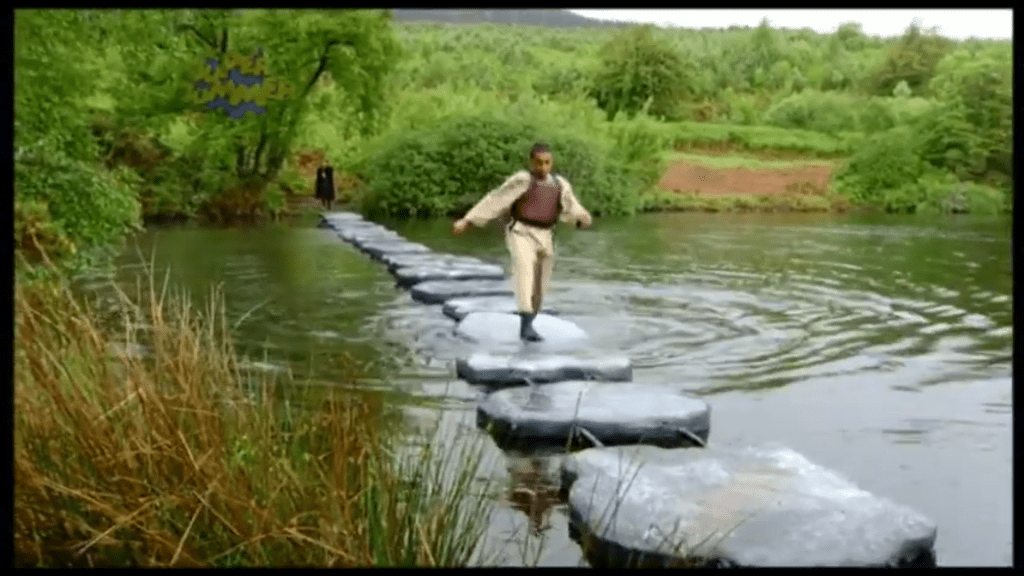
Stepping stones is a simple challenge. The final three warriors of the week take it in turns to attempt to pass from one bank of a pond to the other by moving across a long series of floating platforms, 22 if I counted correctly. If the Warrior makes it across, they gain a ring. If they don’t they lose a life. Simple!

Stepping stones is decidedly a game of two halves, as two distinct methods can be taken when attempting to it. In the words of Raven himself they are: “Slow and Steady, or Fast and Nimble.” One of these techniques, when employed makes for interesting viewing, the other does not. I will give you no points for guessing which is the interesting one. Unfortunately most of the Warriors, quite wisely, choose to take the cautious approach, which makes for less compelling viewing, but a far likelier chance of success, so I can’t knock it too much.

This challenge could function well as an equaliser, rewarding different skills to most of the other challenges in the season. While usually being taller is an advantage in Raven, here it is decidedly the shorter contestants who do better, finding it easier to distribute their weight on the platforms, making them less likely to fall in. It is for this reason that I believe it is a mistake to have it so late in the week, appearing on day 5 when only three warriors remain. If it appeared earlier in the week it would function well to mix up the standings, but so late in the week it typically has little effect on the results, taking away a lot of the tension when watching it.

This challenge does, however, emphasise how awful Raven is to his chosen Warriors. He takes them to a lake, which you can see the edges of, and forces them to instead go across precarious platforms over water. And then, if someone happens to fall in and get wet, he has the gall to deprive them of a life! The power had clearly gone to his head when he devised this challenge, the early signs of a dangerously Machiavellian mind. This could have been a warning, and we might have prevented what happened, but alas, we could not, we were blind to the horror right before our eyes, and the world would never be the same because of it. Anyway, long story short, Stepping Stones is OK.

To Be Continued…

As with everything I write, this has become far too long, so I have decided to split it into parts in the vain hope that I actually finish the list! See you next time while I continue to just kind of chat shit about Raven and seemingly put challenges down in a random order. I can’t wait.

Unlock: Expedition Challenger Review

I was 11 or 12 years old, browsing the internet on a brick of a computer in the library of my school, when, having exhausted all possible joy I could from the high quality browser games I have long since forgotten, I stumbled across a kind of game hitherto unknown to me, ‘Escape the Room Games’. The premise of most of these short flash games was simple, you were trapped in a room and needed to get out. You needed to find and combine items, use details of the environment to solve supposedly ‘logical’ puzzles, and get incredibly frustrated at the futility of pixel hunting, with the experience culminating in a door swinging open and the words ‘Well Done!’ popping up on the screen in comic sans. Needless to say, I became obsessed immediately.

Since the discovery of this genre, I’d be surprised if there was more than a 6-month period in which I haven’t played at least one of these games. Through all the years of playing, I’ve seen the way these games have evolved, the way that people would borrow ideas from each other and improve their own outputs, with varying degrees of success, but even the failures would often be entertaining for the innovation they presented. As time went by, more and more often you would find yourself not merely needing to escape a single room, but a labyrinth, a series of locations in different time periods where past actions affect those in the present, or even jumping between dimensions to solve puzzles. You could feel the shift in what people were making, the drive to improve the medium, the ambition coming through. In retrospect, this led to two major games types emerging, games focussing more on puzzle solving (generally earlier games) and games focussing more on exploration (generally later games). Neither was better or worse than the other, and many games could easily fall into either category, with often the best games being a very good example of both.

However, in recent years, the influx of these browser games has slowed and slowed, until now there are barely any additions to this library of games, and with redundancy of flash fast approaching, I’m sure some will be lost to the ether of the past forever. I find this a sobering thought, these parts of my childhood gone forever, forgotten, but that is the nature of time, they have become outdated, as will all.

Before reading this, I’m sure many of you had never heard of these kinds of games, instead having heard of ‘real’ escape rooms (for lack of a better term) or one of the many alternatives that now exist. And while I have done escape rooms of many types, and in many mediums now, the browser games will always hold a special place in my heart as my introduction to the genre. And so, I can’t help but search for an experience akin to the ones I once had. While I have found ‘real’ escape rooms to be a decent approximation of the puzzle-focussed browser games projected into a physical space, the only result I have found which comes close to encapsulating the feel of both the exploration and puzzle focussed games comes from the Unlock series of “Escape Rooms in a Box”. No other company has been able to replicate the feeling of exploring new places, combining items in odd ways and just remind me of what I used to enjoy so much. And it’s that reason that I’m so critical on them, because I know what they could be.

For those who don’t know, “Escape Rooms in a Box” are escape games which come in, you guessed it, a box! These boxes contain physical components that allow you to get an escape room experience in the comfort of your own home, or, y’know, the comfort of wherever you can take the aforementioned box. Different companies do this in different ways, but Unlock attempts this using (traditionally) only a single deck of about 60 cards and a companion app. This deck consists of numbered and lettered cards that must be used in combination with each other, and the results of puzzles put onto the app to confirm whether or not they are correct. The cards come in different colours that indicate the different features of the cards. Blue and red cards can be combined by adding their numbers together to indicate new cards. Yellow cards indicate a 4-digit code must be inputted into the app. Green cards indicate that some special interactions with the app. And last, and most certainly least, are grey cards which sometimes contain clues, but usually exist solely to confuse you to their significance and add ‘flavour’ for whatever adventure you are currently undertaking. In addition, any of these cards could contain numbers or letters (either explicitly shown or hidden) to indicate additional cards you may use. The Unlock app also imposes a non-optional time limit, adding an extra degree of pressure to these games, with extra time penalties for incorrect answers. An overall grade based on time taken and number of hints needed is also awarded at the end of each scenario; a sure-fire way to make people who believed they’d done well feel worse about themselves when obliquely told that no, they had not. Always a good way to end an evening. What I have just described are the basic Unlock mechanics and mechanisms. Now rip up those ideas and throw them out of the window, because the Unlock series has a dire case of needing to constantly reinvent itself.

At the time of writing, 7 main Unlock boxes have been released, with each box containing 3 scenarios. These boxes have seen an interesting progression, with the first 2 or 3 to be released pretty much sticking to the formula laid out above, perhaps with little changes, like the addition of a map, or a simple change to the app. From the 4th box onwards, however, the series has been pushing in bold new directions, with the most recently released set ignoring the 4-digit codes that were once integral to the game entirely. Now, this advancement could be seen as a good thing, removing the chinks from the slightly clunky system, but unlike most other ‘Escape Room in a Box’ companies, pretty much every individual scenario in the Unlock series was designed by a different person. This leads to a lack of consistency in quality between scenarios, and a lack of cohesion within boxes, but it also has other far worse ramifications. I know that sounds, perhaps, overdramatic, but I promise you, it is, but nothing wrong with a little exaggeration sometimes.

The more modern scenarios released often attempt to deconstruct the nature of the game, however they are being made by people who have never designed one before, so they are not necessarily taking the right lessons and moving forward with them. They change what doesn’t need to be changed and add things which take away from the overall experience. And while future scenario writers can learn from this, it also doesn’t allow previous designers to follow through on potentially interesting ideas that they previously implemented. Though, it would be remiss of me to imply that I believe the Unlock scenarios are getting worse, as that is not the case. But I must comment on this wasted potential, of ideas being thrown out that no-one will follow up on, and of designers trying to run before they can walk. This is all very relevant to the scenario I am talking about today, Expedition Challenger. This is a scenario from the 4th Unlock box, the awkward middle child of the series, knowing it must break away from its roots, but unsure how to do it effectively. And, oh boy, does Expedition Challenger try to break away.

That concludes my ramblings about the background needed to ‘properly’ understand this; yes, ladies and gentlemen, over 1300 words in and only now am I beginning to get to the point.  I fear it is not going to improve from here. Buckle up.

I’m not going to milk this too much, Expedition Challenger is easily my least favourite of all the Unlocks I’ve played; maybe second least if I’m feeling generous (which at time of writing, I am not, which is doubly annoying because it’s one of the most innovative scenarios in the series to date. It presents some genuinely interesting ideas, and immediately ruins them by being bad. It consistently fails to live up to its potential, which is especially troubling with the knowledge that, because of this, a lot of interesting ideas will never be touched upon again. This scenario tries out a lot of new things. And do I think they work? No, no I don’t. It’s terrible. Genuinely abysmal. It fails spectacularly at almost everything it tries to do. But, it at least does it in an interesting way, and frankly that’s worth writing about.

Up until this point I have almost entirely avoided writing about the ‘theme’ of any of any of these games, instead focussing on the mechanics and gameplay. This is because I do not care. I could be trying to find a pirate’s treasure or helping a little boy overcome his nightmares; I won’t care unless the theme is intrusive. Give me clever puzzles and I’m a happy man. But I’m well aware that some people reading this do care about theme (which makes them idiots and wrong, but that’s beside the point) so I will discuss theme here. Though, in this case, I find the theming very interesting, though not for the right reasons.

At first glance, and according to every article about Expedition challenger I could find online (and I checked a lot, just to be sure), the scenario is simply about trying to save a group of people from an expedition that went wrong on an island on which dinosaurs still live. This, as far as themes go, is fine. It works reasonably well as a story in its own right, however, my problem with the theming is not in the plot itself, but in its ability to function as a sequel to Athur Conan Doyle’s “The Lost World”, which it was designed to be. Several other Unlock scenarios have been based on pre-existing works of fiction, such as Alice in Wonderland and the Wizard of Oz, and it was always very clear that that’s what these scenarios were doing. It is not clear here. At all. Maybe it’s because this novel is far less known than the other adaptations they’ve done, but I am yet to find another person to have played this who has realised this was even remotely related to the book until after they had finished it, raising the question of why it’s done in the first place. But being based off a less well-known, though not obscure, novel is not in of itself a negative if something interesting is done with its nature as a sequel. Unfortunately, yet predictably, it is not.

The extent of its reliance on the source material is that a couple of call-backs make a little more sense and you have a better understanding of the people you are rescuing, while also stealing every story beat straight from the novel. Because of this, the fact that people who don’t know the story can enjoy it just as much as those who do know it might appear to be a good thing. However, that is the same as saying an adaptation of a book to a film is good because people who haven’t read the book can enjoy it, even though that is true of almost all films anyway. It is not an achievement to make something understandable to everyone, it is the most basic thing it is trying to do, it’s independent to the matter at hand, which is “Why is this a Sequel?”. The story would work just as well, if not better if the plot were simply “explorers need rescuing and there are dinosaurs”. Nothing of value is added to the Lost World because of this, it in fact takes away some of the interesting story beats from the original work because it chose to merely repeat them. No interesting angles are taken, nothing interesting is done with anything in the book. Compared to the Wizard of Oz Unlock scenario, a lot of the decisions made were done with the Wizard of Oz in mind, making interesting beats and character moments for those who know the story and those who don’t. That is not the case here. So why do it? It serves no purpose, except perhaps to aggravate me. This might seem like a non-issue to some, but every decision the game makes should have a reason behind it, and honestly, I don’t see any reason for this decision. This is indicative of many other decisions made in the design of this scenario, making a decision because you can, as opposed to because you should. But this, as far as the overall experience goes, is a minor complaint. It’s all downhill from here.

The first thing players will notice on playing this scenario is the additional material that comes in the form of a booklet. You gain access to it immediately, and it is used regularly throughout the entire scenario. This is actually a good idea that I can see being utilised very well in a scenario which wasn’t this one. Having a single booklet available from the beginning, that you are allowed to look through in its entirety can allow for some very interesting moments later, such as information that you don’t realise the significance of the first time you read it, or a seemingly innocuous aside being integral to a puzzle later on down the line. However, this is not what this booklet does. When you first look through the booklet, it is immediately obvious what’s useful information and what’s mindless filler, simply there to fill space because they have it. There are several specific pieces of information which seems to have only been included to work as a cypher, and that is indeed all they have been used for. There’s no subtlety or interest there, only mindlessly waiting until some other card tells you what to do, and then you do it. Some useful information has technically been hidden in the flavour text, however these ‘hidden’ details were immediately obvious to be the answer for some later puzzle, so the only real problem solving there was remembering where you saw the information, which was as obvious as it was uninteresting. There was even one cypher included in this which, quite literally, made me groan out loud when I saw it. It’s a cypher often used in escape rooms, but I’ve only ever seen it used in an interesting way one time, and let me tell you, this was not that time. The only thing in the booklet I thought looked vaguely interesting was the map of the island, which seemingly only existed to confuse things later in the scenario. Looking through this booklet set my expectations low immediately, and I still felt let down by the end of it. This is a prop I have not seen another Unlock scenario use, and I worry that they may never do again because of its lack of effectiveness here, which is a genuine disappointment to me.

One of the most important things in any escape room or escape game is the puzzles, and Expedition Challenger consistently presents uninteresting and obtuse puzzles throughout its approximately 60-minute run time. The number of puzzles I thought were interesting in this scenario could be counted on one hand. In fact, they could be counted on a single finger. The puzzle boiled down a neat bit of word play and symbology, based on something simple but with a clever implementation that brought a smile to my face while making me feel a fool for missing it, which is always good for a game of this type. However, this puzzle came in the first 10 minutes of play, giving me false hope for the puzzle quality over the rest of the scenario, which let me tell you friends, was not very good. The worst part is, this wasn’t even a whole puzzle, it was merely one part of a larger puzzle, and the quality of the other parts of this puzzle varied from uninteresting to bad. For this puzzle to be my favourite of the scenario, and by a wide margin at that, is appalling. I probably wouldn’t even remember this puzzle if it appeared in any other Unlock scenario. I may even be remembering it too fondly, as it benefited from being almost immediately after my least favourite puzzle of the scenario. No, that’s being too kind, my least favourite puzzle in the whole Unlock series. Oh, by the way, that aforementioned worst puzzle was the first puzzle in the scenario, way to start on a high note! Though I guess starting low just makes everything subsequently seem better. In that case, it still failed. Nothing could make this scenario appear anything less than terrible.

There are few hard and fast rules I like to apply to all escape room media, but I think saying that something should start and finish well is a simple enough axiom that most people can agree on. It is for that reason that the first puzzle in any escape room is very important. It sets the tone for what’s to come. The first puzzle of this scenario (outside of finding a hidden number and combining a combining a couple of cards) is as unfair as it is uninteresting, and worst of all, breaks one of the cardinal rules of any escape game, it requires outside knowledge. This puzzle took me a long time to solve, despite the fact the actual solution came to me relatively quickly, because I decided that solution would be impossible as the outside knowledge was too specific to be a viable solution. Oh, naïve fool that I was, I was giving the game too much credit. Also, the supposed ‘clues’ to indicate what you should do to find the solution, while not unfair, were abstract enough that even after I had arrived at the correct solution I was not certain. This is never good, it takes away from the joy you feel at finally identifying the right answer. It’s not even an interesting puzzle, it’s literally just reading off numbers. That’s it, using outside knowledge and reading numbers. What a way to start an epic adventure! And this is followed by another puzzle with a clue, while much fairer, also took a long time due to ambiguity in the design, though I fear the fault there is entirely mine. That, plus the puzzle I actually liked, was the first location of the adventure, overall taking up far too much time and setting this scenario off on completely the wrong foot. This was also the only ‘traditional’ Unlock gameplay we get in the scenario, and it wasn’t even good outside of one bit of a puzzle. And this, after the first 20% of the room, is where things really goes off the rails.

Now we reach the rest of the scenario, where things seemed like they were going to get better, then didn’t at all. I won’t get into any specific puzzles or information here, but I will talk about the main gimmicks of the scenario here, so read at your discretion. After you’ve completed the first room of this scenario, you find yourself on the mysterious island of the dinosaurs, and this is represented on the app by a series of different locations you can head to on a simple grid like map. Not to be confused with the much nicer map in the booklet, the one on the app is just a grid. Now this seemed interesting and presented some genuinely exciting prospects early on, and there was a certain sense of excitement initially at being able to go off on an adventure. This joy, along with any other brief sparks of hope in the misery, was quickly quenched because of the additional constraint of saving the other members of the Expedition. Each member of the expedition you are trying to save would die after a certain number of ‘days’ has passed, where you can only make a certain number of movements to different locations before an in-game day passes. This could be interesting and tense if done correctly, although it’s not something I personally like seeing, as it makes me feel like I’m missing out on content. However, despite this, it wasn’t implemented well, so I am absolved of sin when I criticise it, making this review 100% objectively correct.

A large portion of navigating this scenario involved trial and error, and in an action limited environment, that only comes across as frustrating. You cannot travel to certain locations by certain routes, and there is no in-game method to determine this other than by trying and failing, which isn’t a good choice for an escape room that describes itself as being a logical experience. This is especially annoying as every time you attempt to move a location you can’t travel to, you still lose time, penalising you for something you had no control over knowing. The scenario may have been designed with this is mind  (though I feel I am being generous for implying this scenario was designed with anything in mind), but it wasn’t a good choice, and served only to sour my experience immediately of what might otherwise have been an interesting variation on a traditional scenario. To top it off, there is a lack of consistency in regard to the impassable routes. In some cases you have to solve a puzzle to get to the locations, or you require a specific item to pass through, or sometimes you just have to check and fail. However, the way they add time for failed explorations is not consistent. In the latter two examples you will lose time every time you fail to pass through. However for the puzzles, there is no penalty for incorrect guesses, which is frustratingly inconsistent. If new mechanics are introduced, they should at least be consistent within the scenario, even if I don’t like them. Additionally, by adding this new day mechanic, they remove the normal 60 minute timer present, however even that wasn’t properly thought through. The time penalty cards for incorrect answers to puzzles were not removed, meaning there are situations in which you are required to take a time penalty with no mechanical way of enforcing it. This resulted in the ambiguity of whether or not there was still a timed element that you just weren’t privy to seeing, as it is never explicitly stated that the timer was removed. I may not like the timer, but if you’re going to remove it, at least do it in a way that doesn’t promote additional confusion. These are basic oversights I wouldn’t expect to see in an Unlock product, or any escape room product at all.

Now, you might be thinking that if some of the other features added in this scenario were used well, it might make up for this whole thing? Theoretically, maybe. In this example, ha, no! It’s all terribly utilised. The principle other addition the map added was tying certain objects to certain areas of the map. This seems like an interesting idea on paper, the same as with most ideas this scenario presented, however it falls down because there was clearly a lack of thought as to what could make these puzzles interesting. The ideas were conceived, and left to die, no-one ran with them to see just what they were capable of doing. The objects which could only be used in specific locations were dull, nothing interesting was done with the gimmick other than occasionally forcing you to backtrack, everyone’s favourite past time. There are a couple of instances where these stationary items should have been included for thematic reasons, but weren’t, making the entire presence of the feature feel like an afterthought only included to increase the length of the game. There are also a couple of items that act differently in different areas, but in very boring ways where it’s obvious when and why they should be used. Again, no imagination. It introduces new mechanics and doesn’t do anything with them, that’s just bad design.

Another ‘innovation’ this scenario attempts to introduce is shaking up the way machines work in the game. Again, not a bad idea on paper, but it’s executed poorly here. In case you’ve forgotten since I last mentioned it several thousand words ago, machine cards are cards when you have to use an app to interact with the card in some way. Typically these are as simple as select the right option to advance or press the buttons in a specific order to reveal a new clue. Here, however, there was a lot more variety in the way machines are used, and I applaud their ambition. Outside of the first use of a machine in this scenario, which was used to enter a code, every machine was doing something that hadn’t been attempted by Unlock before. There is one machine I liked quite a lot, emphasising how the app, for all its flaws, can be used to enhance the experience. However, this was the only machine I had positive feelings on. Several of the machines required experimentation to determine how they should be used but penalised you for experimenting in the wrong way. And in another case, you test to determine what this machine can do, only to be penalised for solving the puzzle ‘too early’. This takes away from the ‘Aha’ moment of solving the puzzle, at is immediately undermined by being told, even though you have given the correct solution, you are penalised. Two other machines are the worst of the bunch however, with one being used solely to give an audio ‘hint’ that existed only to confuse, and was possible to solve without it existing at all. The other involved literally pressing a screen at random points until you win, which feels counterintuitive in a game when you are supposed to use clues and logic to solve puzzles. There was no indication you could do this as far as I could tell. You just did it. Other uses of machines in this scenario are mostly fine and basically respond to solving codes without numerical solutions, however seeing as the time limit is gone, penalisation for wrong answers no longer exists so guessing no longer results in any penalty whatsoever.

Now to the most egregious part of the scenario in my eyes, the lack of any interesting puzzles in the last three quarters if the scenario. Not a single puzzle caught my attention for more than a few moments. People often seem to think that easy puzzles are bad, and hard puzzles are good. I disagree, it’s what the puzzle does that makes it compelling, a clever solution to an easy puzzle is satisfying while a stupid solution to a hard puzzle is not. So, despite having a mix of easy and hard puzzles in the latter parts of this scenario, none were good. I might call one mediocre if I was feeling generous. Most of the puzzles are boring and/or unfair in their execution, so boring that I find it very hard to say anything interesting about most of them. A couple of them require leaps of logic that, while solvable, were not satisfying because you were surprised the answer was correct. That’s never a good feeling to have as a player. There are also numerous examples of times when I knew what the solution was, I had had the logical jump, and I was simply unsure of how to implement it, truly the definition of frustrating. And then, in the worst cases for me, where logic appears to go out of the window and you are left with correct solutions they will not let you use. As an imaginary example, unlikely to appear in a real game as it would be utterly ridiculous if it were to make it through playtesting, there is a situation where you have fire, and you know there is a previous location in which you can’t see, and you are unable to use it there. Stupid, right? Oh no, wait, I mixed up my examples, that is what they actually did. Furthermore, the use of red and blue combination cards in this scenario are poorly done throughout, where all the answers are immediately obvious or utterly unobvious. I wish I had more to say on this, but frankly, the puzzles were so uninspired I hardly have the energy to do so, so I won’t.

As I proposed previously, most escape games should be deigned to start and end well. Having already explained how the start of the scenario failed, I will now elaborate on how the end of the scenario was also disappointing. In the closing sections of the scenario, I would expect something at least a little memorable. But, alas, even compared to the rest of the scenario, the last few minutes will be uninteresting to the player. Of the last few puzzles, none feel particularly interesting or clever (even when compared to the rest of the scenario), leaving the players feeling unsatisfied. This scenario also fell down the hole that many Unlock scenarios do, ending too soon narratively. You solve the final puzzle without realising it will be the final puzzle, making you feel like there should still be another stage before the end, leaving a further sour note on finishing the game. In fact, that’s not a bad way to describe the whole game. One prolonged sour note.

Overall, the whole scenario just isn’t very good. It reaches for the sun with its ideas and then burns up. So, it may surprise you when I in fact recommend purchasing this scenario if you like the Unlock titles. It comes packaged with two other (far better) unlock titles which are worth your time trying, and is a really interesting case study on seeing how to design any escape game. I always like experiencing good and bad examples of a medium, as it lets me understand what works and what doesn’t more clearly, giving me a better appreciation for why things work. And even if I personally didn’t like it, I know that opinions of Unlock scenarios people vary wildly from person to person.  Many of the other people I have talked to have lauded this scenario, and while they are stupid, they are entitled to their own dumb opinions. (If that comment applied to you, and you were offended, fear not, that comment was facetious. I do not actually believe you are dumb for liking this scenario, I believe you are dumb for a multitude of other far more glaring and egregious reasons.)  And, to its credit, there are a couple of things this scenario does very well indeed. It has a real sense of urgency, and no other scenario has been able to adequately replicate the feeling of exploration, and although I don’t agree with the success metric they use, having additional degrees of success makes for a nice change. And even if it’s bad, it’s really cool to see one of the series’ first forays into seeing just what it was capable of. I just wish it had been done better, because if they’d pulled this off well, this would have easily been in the upper echelons of scenarios on innovation alone. Hopefully, as the series goes into the future someone will take the ideas that worked here and give us a much much better scenario than this. But until that day comes, and forever after, Expedition Challenger will remain trash.

The First Thursday

It will happen on a Thursday. That is the only thing I can say for sure. I set the mechanism, it can become active once every seven days. Once a week. Every week. Any week. Always a Thursday.

This is a confession. That much should be obvious. This note’s existence is proof of my guilt. I will not elaborate further, it is unnecessary. I do not want anyone else to blamed. This was a solo endeavour. Others would not understand why I do this. They could not be involved.

I do not expect to be alive when you read this. There is a small chance I shall be, that must be acknowledged. If so, do as you must. I will not resist. Though I hope it will be after my death. A selfish hope. The guilt would be immeasurable. I do not know how I would cope. In death I will not feel guilt. I will not feel proud. I will feel nothing. It is better that way.

I worried for a long time. What if I made a mistake? Perhaps I set the cycle to repeat every six-point-nine-nine-nine days. Compound the error, and then I am wrong. I cannot be allowed to be wrong. And what of clocks, calendars? They have changed before, they could change again. What then? In wilder moments I worry the week will be replaced. Thursdays, obsolete. I think of the death of humanity, of Thursday becoming forgotten to time. Those are foolish fears. I see that now. It does not matter what happens. When it happens. This moment I create is the starting point, the definition. So I must be right. When it happens, it will be a Thursday. All other Thursdays shall be defined from that. A universal truth. The first Thursday. Yet to come.

I do not know when the day shall arrive. I have neither that right nor that arrogance. It is inevitable. That is all I need to know. That is all any of us need to know. The knowledge it shall happen. And the day it shall happen. A Thursday.

I have one request. I do not expect you to acknowledge it. I ask anyway. Do not speculate. Do not read more than you should. It is not Thors-Day. It is not T-Hers-Day. It is not the Furst-Day. It is Thursday. The whole in of itself.

I will explain why I did this. I do not promise you will understand. You will not understand. Imagine you are an adult, thinking back on being a child. In one hand you hold the tail of a kite. It is flying, for in all memories with a kite it must fly. It moves through the air. You remember the motion. You feel a pull. Your grip is firm. You do not know what day it is. It did not matter to you. You hear someone call you. It was your mother, but this is a memory, you do not remember. Your grip loosens for a moment. You feel a release, an emptiness. You reach out. It is gone. You look up to the sky. It is empty. Then the memory ends, and you are alone. You were always alone. You look outside your window. It is dark. You think you see something move in the distance. It is a Thursday.

Ace Attorney: Phoenix Wright: The First Turnabout: How to Start a Series

The Ace Attorney series is a surprise success story in the West from what would be expected to be an obscure Japanese franchise, and yet this video game series with mountains of text and very simple gameplay that’s about the Japanese legal system is still popular today. The fact that a lot of you will have heard of this before you even read this article is a testament to that. This series now sprawls over eleven games: six in the main series, two different spin off series with two games each, and a crossover game with Professor Layton (bet it’s a long time since you thought about that franchise), not to mention the animes (yes, there have been multiple at this point), movie, and stage plays (multiple of these too somehow). A lot of people will look at this game and call it weeby and bad, and on one count they are right, on the other they are wrong; I absolutely love this series, it’s great. It is very weeby though, can’t do much to argue against that, oh well. I have played nearly every game in the series, only excluding the one not yet translated into English through either legitimate means or fan translation. And, to my genuine surprise, they’ve all been good. Sure, some are better than others, but I’d be hesitant to give any a negative rating, which is extremely impressive for a series with its longevity. And to celebrate my enjoyment of this series, I have decided to write a series of articles about it, or maybe just this one article, depends on how bored I get.

The Ace Attorney games are a visual novel series about defence attorneys trying to get their clients found innocent. And for those who don’t know what a visual novel is, it’s a partially (and sometimes not at all) interactive story with music and visuals used to ‘enhance’ the experience, though I know more than a few people who would probably prefer them if they were just books. Each game in the main series is made up of several cases, or episodes, in which you must defend a client from a crime of which they have been accused, usually murder, meaning you can keep it light hearted and silly and not break tone, because, as we all know, murder is a funny crime. Obviously the game wouldn’t give you much to do if these chumps you defended were guilty, so it’s your job to get these innocent idiots found not guilty, or they’ll be executed. Although thinking about it now, a game in which you play as a crooked attorney could be interesting, fixing evidence to get your clients off, but I don’t think it’s quite the tone the series is going for, oh well. Now, how do you get your clients off? That’s right! You find contradictions in blocks of text! Yes, you heard me right! You contradict witness testimonies until you find inconsistencies! It’s the best! Like genuinely, it is. It’s shockingly compelling. But anyway, by finding these discrepancies you progress the story and get closer to finding the truth. Do this enough and everything comes to light, usually in a dramatic fashion. You also investigate crime scenes, but people care less about those bits, though they function well as vehicles for stupid jokes. Also, the series loves the word turnabout a bit too much, especially for a word I’ve heard maybe once in any other context, but those are minor annoyances at most. But in the end, even though some of the spin-offs are slight variations on this, and newer games add more features, all the games boil down to the same few fundamental mechanics in finding lies in statements. And it works, it really does.

I could talk about a lot of things in the series, from the great music to the (usually) fun characters, and I am going to be talking about them a bit, but what I’m going to be focussing on here is ‘The First Turnabout’, which, it might surprise you to hear, is the first case in the series. Well, the first case in the first game released, not the first chronologically in the timeline; this series likes to mess with the ordering of cases, for better and for worse; usually worse, but that’s beside the point! There are a lot of interesting things in ‘The First Turnabout’ which I will try to properly discuss here, but the main reason I wanted to write about it is because I believe it is one of the best introductions in any video game franchise, and I’d like to try and articulate why exactly that is. Fair warning, I can’t properly talk about the case without going into specifics, so there will be spoilers for the whole case here-on out, and I will be going into a fair amount (read, too much) detail, but I genuinely don’t believe it will affect your enjoyment of the case significantly.

The first thing I want to say about the case might sound like a negative, and that’s because it definitely is. Out of the fifty-four ‘turnabouts’ from all the released games, this case is nowhere close to the best cases, it’s probably not even particularly close to the top half. What a way to start an article about why this case is great, by saying it’s comparatively terrible! But there’s a reason for that. ‘The First Turnabout’ is fundamentally incapable of being a great case in its own right due to the fact that it does such a good job at being an introduction to the series. It can’t be as complicated, or have as many bells and whistles, as some of the other truly great cases in the series. Some other cases in the series have attempted to function as good jumping in points, and are often much better overall cases than this one (Turnabout Trump comes to mind as the only other particularly strong jumping in point), but no other case comes close to encapsulating what the series is about compared to this one.

One of the principle ways ‘The First Turnabout’ achieves its success is through its length. It’s by far the shortest case in the series, rocking in at a whopping thirty-ish minutes total playtime (depending on reading speed) for people who have never played the series before; whereas most cases are at least a few hours in length, and some significantly longer than that. But that’s not a bad thing for this case, in fact it’s a huge point in its favour. Its brief length makes it for more accessible than any other case in  the series, anyone who is interested can pick it up to see if they like it, and in thirty minutes they’ll be done. Even in the short amount of time you play, you get to see a lot of the best things this series has to offer, admittedly in a diluted form, but if it’s your first time playing you don’t know that, which is the important thing here. I don’t believe many, or any other series, has an opening thirty minutes which are as representative of pretty much everything the series can offer; all the core mechanics of the game are introduced immediately, from that point on you’ll know what you’re getting. And at the end of this case, someone will know whether the series is for them or not. And yes, this game won’t be liked by everyone, it’s a bit… niche. And wordy. And anime-y. All of which are valid reasons to not like it, but by playing this case you can know for certain it’s not for you, just as easily as you could play this and know this will be your new favourite video game series. Knowing if you want to sink the next twenty or so hours into a game after thirty minutes is a huge achievement, and I must give credit to this design. Admittedly, this part of the design wasn’t intentional, it comes as a combination of the game boy advances hardware capabilities, and the last-minute decision to include this case. But even though it wasn’t planned, its brevity truly makes it the best hopping on point for the series.

Whenever anyone plays a game they come in with expectations. In a platformer you expect less focus on story and more of a focus on tight gameplay, in a game about zombies you expect gun combat and very subtle references to the fact that maybe humans were the real villain all along, and in a story driven game about lawyers defending clients from murder charges you are going to expect some kind of murder mystery. And this series delivers on that! With a few differences… Personally, I love the murder mystery genre, but there is only so much it seems you can do with it. Traditionally in murder mystery media, you expect to be presented with a list of suspects, one or more of whom committed the crime, then, given clues, the suspect will be caught and all the world’s problems will simultaneously be fixed. Typically, the culprit comes down to being the person who had the motive, the means and the opportunity. Find who has those and you’ve solved the crime. Obviously, this is a very simplistic way of looking at things, and pretty much any decent media that utilises this trope messes with the formula a bit, or at least does something interesting with it, but many series are based on this basic structure. The Ace Attorney series is no exception. Every killer in the series had the motive, the means and the opportunity to commit the crime, but that’s often barely important outside of the narrative justification.  This would seem like an odd thing, were it not for the fact that the series also doesn’t particularly care to keep much mystery in the ‘who’ of whodunnit, often revealing the culprit immediately.

In the opening cutscene of ‘The First Turnabout’, the killer is revealed, and bam, you know the culprit less than thirty seconds in. This, quite frankly, is a brilliant move for the series because it tells you what king of game this is straight away, throwing any ‘whodunnit’ expectations out of the window immediately. This levelling of your expectations to show what the game actually is, not what you thought it would be, is a smart move to get out of the way as quickly as possible to avoid disappointment. This series, instead of being based on traditional detective stories a la Hercule Poirot, is much more based on the detective stylings of Columbo. He always knows who did, and he just has to prove it, and that’s exactly what you do here. You know who did it, how they did it, now all you have to do is prove it. Whether that’s through the motive, the means or the opportunity to have done it. In the first case it only really focuses on one of those, the means. Prove the murderer was in the room at the time of the crime, and you’ve proved they must have done it. And even though in some cases you focus on different aspects of the murder, that’s how the whole series basically works. Confront the guilty party until there is no option other than for them to admit defeat. Knowing who did it doesn’t help you do this, as you still have to prove it, in fact, knowing who did it raises the thrill of the chase even more. And this case sets up that scenario perfectly. From the moment it starts you know this isn’t going to be a traditional murder mystery, you’re going to be catching out the bad guys, and by playing through the rest of the case you’ll have accurate preconceptions going into the rest of the game, and the rest of the series.

Next, I’ll talk about the thing people usually associate playing games with, gameplay. Gameplay in the ace attorney series is different from other forms of games, because it’s almost entirely text based, everything in the presentation can be considered gameplay, from clicking through the text, to the cycling through the wrong answers to get funny lines of dialogue, but in this section I’ll be focussing on the mechanics of finding of contradictions in testimony. In every case in the series, you are given evidence of a crime, which you then use to prove that what a person said is incorrect. This is done during witness testimony, which is an account in their words split into smaller lines of dialogue. One of these sections will contain a direct contradiction to some of the evidence you possess. Present that evidence and prove the witness is wrong or lying. Then, you do it again. This is the basic gameplay loop that’s repeated through the entire series, and it’s in ‘The First Turnabout’ that most players will experience it for the first time, so it had better leave a good impression. Fortunately, it does!

Unlike most other cases, all of the evidence is given to you before you have the possibility of using it. This allows the player to see everything they will be dealing with without missing anything or being overwhelmed by the sheer volume of evidence, of which there are only five pieces, including the ‘joke’ piece of evidence of an attorney’s badge, which is a joke I find funny to this day. Each of the ‘serious’ pieces of evidence are actively required to be selected in the case at some point, even those which might initially seem inconsequential. Through this use of game mechanics, the player is taught that all the evidence given in the game will be useful, however irrelevant it may seem at first.

In this case in particular, it is possible to identify how a narrative can be told through the gameplay, and how it draws people into understanding the correct ideas in the game they are playing. I’ll admit the first few active player choices made are slightly tutorial-ish and in your face, but they take up less than a couple of minutes of playtime so they’re fairly unintrusive, and teach you how to look at evidence. Additionally, some of the cases funniest moments are present in the wrong answers should they be selected, as well as some other choices you can make before the witness testimonies start, and the humour will do a lot to keep the player entertained even if they are feeling patronised. After that though, the first witness testimony begins, and some clever choices were made by the developers to make it an effective narrative and teaching device. One of the most important moments in a game is when you first get to use a core game mechanic, so the first cross-examination in this case is very important. The testimony itself is ten textboxes long, making it one of the longest in the series if I’m not mistaken. This length might initially seem like an overcomplicated choice for a first case, however the contradiction only comes up in the ninth of the ten textboxes, and based on the time the crime occurred, which is something everything can immediately identify as a potential sticking point in the story. By including the contradiction so near the end, the players will have read through almost the entire testimony, and not just skipping once they’ve realised the contradiction, which is a good habit for the game to teach you. The next two testimonies from the witness get shorter, at six and four textboxes respectively. The second contradiction you find is related to a blackout at the time of the murder, and functions well as a slightly less obvious contradiction that uses a slightly more abstract line of thinking, teaching players to think in different ways when looking for the contradiction. The final testimony is a gimme, being very obvious in the mistake that the witness made, but the function here is not to teach the players the mechanics of the game, but to give the players a feeling of accomplishment that they have caught the culprit in a desperate lie. The shortening in the testimony length also lends to this narrative, as with each successive testimony you feel to culprit getting more and more panicked. This technique in changing the testimony length is incorporated in many cases in the series, not just this one, but is effective here as the player will likely not realise this is happening, and be drawn into the story more naturally. Following the testimonies, only a single piece of evidence need be presented, however this is a slightly more abstract idea, though still basic, based on time-zones. Including parts of the trial where you present evidence outside of witness testimonies reiterates the importance of evidence to the player, and shows that an understanding of the evidence is needed at all times. Another nice feature of this case is the ability to show evidence to the defendant after the trial to make them feel better, showing the versatility of evidence in the game. Overall, the gameplay in this case is used expertly to teach the player about the game, while also enhancing the experience of the player, making them more likely to continue playing the game.

One of the most important things in any ace attorney case is the characters, they are the vehicles that drive the story and keep the player invested. An incredibly clever case with interesting twists and turns can be let down by, frankly, incredibly annoying characters, and has been in the series before. But luckily this case makes good use of the few characters it introduces, for the most part. There are only six characters present in the case (not counting the victim), making it a very small cast for an ace attorney case, allowing new players to get a reasonable feel for some of them.

The most important character introduced in this case is the protagonist himself, Phoenix Wright. He makes a very good first impression here, being funny from the outset, while also endearing himself to the audience through his dry marks and exasperation. He’s a very relatable protagonist, which is good for the series as a whole, but is especially useful in a first case, as it allows the player to put themselves in the mind of Phoenix easily. This is doubly important for a visual novel, as the voice you give the protagonist will keep your enjoyment of the game. Phoenix isn’t perfect here though, being slightly too stupid during the earlier stages of the trial, though that has stopped completely by the end of the case. As this is his first trial, though, his naiveté makes sense, and allows for the new players to take on the role of playing him easily. Even then, throughout the case Phoenix is shown to be an interesting character, with multiple funny quips and some eye-catching animations, especially his iconic accusatory pointing.  (I usually hate the word ‘iconic’, but it isn’t even an exaggeration here, it’s just the truth.) Even in the short time you get to spend with Phoenix this case, you get a feel for the character and understand his decision making, which massively helped by his internal dialogue.

The second most important character in the case is the villain of the piece, one Frank Sahwit. So named because he says he saw it. Get it? It’s a pun! The series is full of these puns, many as bad as (or worse than) this, which is just another reason why this series is great! While every other living character in the case will appear many times again in the series, Sahwit is the one people will probably remember the most from just this case (though he does have a small appearance in one of the spin off games). He is the principle antagonist to the player, even more than the prosecutor, so making this character memorable and engaging is important to keeping players interest in the series. Sawhit works very well as an introductory villain in this case, as his comedic and incompetent character works well in making him a believable foe for the player to beat in their first trial, while also being satisfying and entertaining in bringing him down. He says a lot in the case, but the thing most players will remember about Sahwit comes from his breakdowns. Breakdowns are one of the most memorable features in the ace attorney series; they are sprite animations which detail someone, often the culprit, breaking down after being confronted with the truth. The two breakdowns Sahwit gets are both memorable and comedic, and will probably be the thing people will remember most about this case after finishing it. By making the first villain in the game function well, the audience is much more likely to continue playing the game, as it is the conflict between he protagonist and culprits which is at the heart of the games.

Larry Butz is the defendant of the case and fills this role well, but is still perhaps the case’s weakest character. He can easily come across as annoying and obnoxious to some players, as opposed to endearing, with his womanising ways and ungodly stupidity. However his relatively small amount of screen time will lead this to be not too much of a problem. I also know of some people who really like him as a character, and even though they are obviously wrong and among the stupidest people to ever live, they are entitled to their opinion, so this issue won’t apply to everyone. And even then, Larry’s character isn’t actually particularly important to this case, because what he brings to this case are the stakes of the case, he’s who makes you not want to lose. Larry and Phoenix are childhood friends, and if you lose this case Larry will be found guilty of premeditated murder. This makes a compelling reason for the stakes to be high throughout the case, meaning even with the short playtime, players will be invested in playing the case to the end.

The last three characters function more as plot devices than characters in their own right, though that isn’t a negative for a case this short. Mia Fey is the other character Phoenix knows prior to the case, and acts as the mentor figure, helping out Phoenix, giving a narrative reason for some of the tutorials in the case, which is always a nice inclusion in a game. It is also her potentially unfortunate future that is the hook appearing at the end of the case, giving motivation for players to continue playing the game to see what happens to this character they know. The Judge and Winston Payne are the last two characters in the case and fill the role of judge (shocker) and prosecutor respectively. Both have more character in future cases, but are, rightly, left as fairly blank slates here so that the new player can get to the meat of the gameplay quicker. They also both perform the role as being secondary opposition well, showing that is not just the culprit that the player must overcome, but also the court itself.

The last major point I would like to discuss is how the case uses its presentation, primarily using sound and music, to build excitement in the player, making them want to continue playing the game after this initial case. The sound design in the game is phenomenal, and is helped by the fact that pretty much every track in the game holds up in its own right. There are some very clever decisions made regarding the sound in an ace attorney case, not just in this case, but in almost every case in the series, however I feel this will be particularly impactful for first time players so am choosing to discuss it here. Interestingly, one of the strongest uses of the sound design is through having the music stop playing when the player finds a contradiction, This immediately tells the player that they were correct, while not breaking up the gameplay, while also leaving the gap to change into a different song unobtrusively at the most opportune moments, and these moments are picked very well. There are two such themes that start after these breaks, called ‘Objection’ and ‘Cornered’, and the best word I can think of to describe the music is ‘hype’. The tracks both do an incredibly good job at getting you pumped, and leave that feeling with you throughout most of the case, especially the climax. New players when reflecting on the experience will remember these moments of excitement, helped in large parts by the music, leaving a lasting impression. The breakdowns mentioned previously also utilise music and sound effects well, as well as exaggerated comical animations, helping in their memorability. The other major use of sound in these games is through limited voicework in certain lines, such as ‘Objection’ and ‘Hold It’. These sound-bytes will, again, stick in your mind after you play, as they are also used at well timed moments to keep up the excitement. Surprisingly, this effectiveness if emphasised by the rest of the dialogue being sound effects as opposed to full voice acting. All of these together combine into making the first case a memorable experience for first time players and veterans alike.

Also, the case is also genuinely really really funny, but I couldn’t find a spot to really talk about this anywhere else that wasn’t massively obtrusive, not that it isn’t unobtrusive here. Some highlights include Phoenix calls Mr. Sahwit ‘Mr. Did It’, which genuinely never fails to crack me up, because I’m a child. The comedy present in this case does, however, accurately portray the tone the rest of the series goes for, and if people find it funny they are more likely to carry on playing. Anyway, this is the correct way to end a serious analytical piece! End on the strongest point, and for this case, the strongest point is a man getting a toupee thrown in his face! Wooo!

In conclusion, while ‘The First Turnabout’ is hardly the pinnacle of all Ace Attorney cases, it is the best introduction the series has ever had, and holds up well even twenty years later. I hope the points I’ve made will help you understand while people picked up this game, and after playing this little case realised it would be one of their favourite game series. It’s a very good jumping in point, and if you haven’t checked out the series before, I’m sure you’ll enjoy it, or at the very least not hate it, or you will just hate it, this game series ain’t for everyone. And if you’ve played the games before, maybe go back and play the case again with a more critical eye to see how it effortlessly draws people in and keeps them playing. Every form of media has to start well to keep people invested, and the Ace Attorney series managed that. It’s why people are still playing and loving this series to this day, all because of this lovely little case.

Yu-Gi-Oh! Sevens: Episode 1: Review

Hey hey Yu-Gi-Oh! Fans! It’s ya boy Kyle back here again to explain why Yu-Gi-Oh! is the greatest media about a card game ever. From the TV shows, to the movies, to the other stuff I’m sure they make but I don’t care about, they’re all great! Today I’ll be talking, well writing, about a Yu-Gi-Oh! TV show, but not just any Yu-Gi-Oh! TV show (of which I am sure there are thousands), but Yu-Gi-Oh! Sevens, a new show of which I have seen only a single episode, but already know this is truly the greatest work of literature since Shakespeare penned Pericles. (For those of you who might not be in the know, the joke here is that Pericles is pretty shit, but I’m sure this note is redundant, seeing as people who enjoy Shakespeare are merely a subset of people who watch Yu-Gi-Oh! related media.) Not since Yu-Gi-Oh! Vrains (the last main Yu-Gi-Oh! series released) have I been this excited about the start of a new Yu-Gi-Oh! series! That’s why, despite there being like 5 episodes of Sevens released as of writing this, and the show currently being on hiatus, I have watched the first episode on repeat in a windowless room with no light except for that of my TV’s screen, and the metaphorical light Yu-Gi-Oh! brings to my otherwise meaningless existence, just so I can properly appreciate its majesty.

So, ‘What is Yu-Gi-Oh! Sevens about?” I hear you cry. Yes, there are also shouts of “Kyle, why are you reviewing this? No-one, not even you, cares about this!” but I choose to ignore those as otherwise I would be sad. Well, sadder. Now, this might come as a surprise to hear, but this show is about hit-children’s card game Yu-Gi-Oh!! And this time that description proves to be doubly true, seeing as Yu-Gi-Oh! has decided to do the revolutionary thing of having actual children play the titular children’s card game. And not even teens, primary school kids, i.e. real children and not weird young grown-ups. Although, if the previous series are anything to go by, the physical and mental anguish these characters will undergo, by being basically tortured through card games as well as watching the deaths of many friends and loved ones (or being said friends and loved ones) will hit pretty differently with this much younger cast; and I personally am all for it! I can’t wait to see the great character development as literal children have to come to terms with the futility of life and thorough hopelessness of their existence through the medium of a fun li’l card game. However, this first episode went more subtle on the darker themes than I had previously hoped, but there are presumably hundreds of episodes of trauma left for these characters (which I already know and love) to feel, and I look forward to it. I look forward to it a lot…

One of the most important things in any tv show, and this show is no exception, is the card games. And Yu-Gi-Oh! Sevens does not disappoint! There’s a whole new type of duelling introduced in this show, and at first glance, it seems like a bit of a broken mess, fitting the Yu-Gi-Oh! brand perfectly! But why has a new type of duelling been introduced? Is it because it’s a new series and there seems to be some kind of legal mandate that the fundamentals of a card game must be dictated by the release of a tie-in tv show? Yes, but also its (apparently) meant to make the tv show more approachable for those uninitiated in the world of Yu-Gi-Oh!, which at this point I assume is predominantly new-borns and Mormons. And this is the perfect time to jump into the show, as in addition to all the old rules, there are new ones to know to learn now too, so newbies can be just as confused as all the existing fans when they struggle to grasp the rules of a game they once knew, though it now appears unrecognisable before them, permanently altered by the inevitable (yet still cruel) breath of time. The newest form of duelling here is of course the Rush duel, so called for the quick nature of the duel and, seemingly, the attitude taken when devising the rules. I won’t bother explaining the rules here, both because I don’t want to and because I think it’s funny to leave large holes in comprehensive ‘review’ which acts as more of a, hopefully, comedic think piece. Needless to say though, rush duels appear to be quicker (at least in terms of the number of turns taken to finish the duel) than the previous standard rules. Now, when I first heard of this change, I believed it could only be seen as a negative. Surely this would mean that less of the (hideously short) 24 minute runtime each week will be dedicated to card games, and more will be spent on fleshing out the characters, advancing the plot, and being put to much better use than on a tedious and terrible card game! But fear not, friends, for I have more faith in the show than this. I truly feel this decision was not made to include less card game, but more! In past series a single game could comprise multiple episodes, but now this will no longer be necessary. Instead of waiting weeks to see a duel finish, giving time to build suspense, have numerous turnabouts, keep you guessing until the last moment, and build narrative intrigue, they can instead just reduce all of that impact by doing it in 2 turns instead of 40, taking 5 minutes. This will also allow at least 4 duels per episode by my counting, and anything that will increase the number of duels I can watch in an episode is only a good thing! The most important impact of rush duels though, is this. No longer before each duel will you need to ask, “What is the difference between tribute, fusion, ritual, synchro, xyz, pendulum and link summoning?”, “Is this a regular, turbo or action duel? And if turbo, are we using speed world or speed world 2?”, but additionally “Are we playing with standard rules or rush rules?” It could not be simpler! Truly, never has there been a better, simpler time for joining the Yu-Gi-Oh! community!

Another, far less important, aspect of the show comes from the characters and their interactions with one another, being especially important in an opening episode. From my vast Yu-Gi-Oh! knowledge and subtle indications included in the first episode; I believe I have managed to pinpoint who will be the four main characters of the show. Now, as I’m sure we all know, judging main character status by those who appear in the first episode is not always wise in Yu-Gi-Oh!. You need only look at the characters who are important in the early parts of Yu-Gi-Oh! GX and Yu-Gi-Oh! 5Ds to see that the people who are best friends with the characters at the start of a show  can often be completely written out of the show for no reason, but this is one of Yu-Gi-Oh!’s many charms. Nothing can keep you guessing more than the fear that your favourite character will drift into the obscurity of background character status. Do you remember Rally, or Chumley? Of course you don’t, they didn’t matter in the long run, why waste time thinking about them, and for you all know I could have made them up! They were important for a few eps, but then were written out, meaning they had to have been bad, because why would you write a good character out of a show, especially in a series as meticulously planned as Yu-Gi-Oh!? Just let them die already! So, these characters I have identified have to be taken with a pinch of salt, for even though they are important now they may not be later. The first clue to who these four characters were came from their appearance. You need only look at the hair colour of many an anime character to instantly see their protagonist potential, and that was factored into my equations here. Characters who speak and take up a significant amount of screen-time are more good indicator, as that is what characters in a tv show do. A character who does not do that can sometime, in fact, not even be a character in a tv show, and may instead just be a wall with a face drawn on it , a mistake I know too well we have all made before. Next, you must consider the narrative implications of the character interactions, and of the overall way they could be used to interact with the world in meaningful ways, and if you think they can do that you’re probably not watching Yu-Gi-Oh!, but some other, better, TV show. And lastly, but least importantly, they are the only four characters to appear in both the opening and closing credits, but really, who cares about that? It’s just music innit, doesn’t mean anything does it? Replace all music with audiobooks I say! The world would be a better place… So, without any further pontificating let me introduce you to the characters who I believe will be important to the show.

Yuga (not to be confused with Yugi, Yami Yugi, Yuki, Yusei, Yuma, Yuya, Yuto, Yugo, Yuri, Yusho or Yusaku, the previous Yu-Gi-Oh protagonists that I didn’t even have to make up) appears to be the protagonist, because of his name, which is like the names of the other protagonists, because it begins ‘Yu’, like the ‘Yu’ in the name of the show. Also, he has hideously over the top hair, but far more tame than most of the others, which is a real disappointment if I’m being honest. Overall, it was these very subtle hints, and I’m not sure how I even picked up on them, that lead me to this conclusion. Truthfully, the only way I think I could have known is my intrinsic love of Yu-Gi-Oh! leading my thinking, or perhaps even destiny. Anyway, as with all the other characters, he is a literal child who goes to school, rides a really lame bike, and is also a world class hacker/inventor, but no-one really comments or cares about that. They don’t even bat an eyelid. Not even his parents, assuming he has them, which I don’t, because they haven’t appeared yet so probably don’t exist. That’s how it works on TV. Without parents shown, I’ll assume he was just created in a moment of pure duel-energy (I’ll call it ener-d for short, like energy, but for duelling, hence the d). So, like Jesus, Yuga came into the world to spread a message of peace and love and a new form of fighting with long-dead beasts that should still be feared and revered in equal measure! And, just as Jesus created link-summoning (I haven’t watched Vrains, which introduced link summoning, but I assume that’s how that summoning technique came to be), Yuga created the infamous Rush-Duel. Perhaps that he is a mere child could explain the terribleness of this new rules set, but seeing as he has been shown to be a veritable hacking genius (capable of performing complicated modifications on both bikes and duel-disks, both of which are banned practices and therefore having extremely limited documentation) this cannot be a mere coincidence. It is intentional on his part. He created this hellish new game for a reason, and though I know not what reason this was, I hope to God that he is inspired by good and not evil. A cosmic joke as opposed to an unrelenting masterplan of eternal pain and damnation. If he was truly born like Jesus through excess ener-d, we must remember that Lucifer too was once an angel. So, though Yuga appears to be of pure heart, and a harmless child who only wants to improve the world he lives in, doubt him, he may be damned only time will tell. But anyway, what’s this prick like? I am sure that there is something more to his character than the mere charade I have seen thus far. His whimsical carefree attitude filled with giant duel-robot daydreams (which are dumb and cool in equal measure) and his catchphrase: “My! Road!”, which he only said once, perhaps twice, during in the episode (though I know this because a couple of no-name characters said it was his catchphrase so it must be true) can only be misdirection for his ‘surprise’ betrayal. Though I expect many casual fans of the show to be duped by this, I, and I hope you dear readers now that you know of this, will not be fooled. But, we are only at the end of the first episode, so we must wait. And wait I shall. Eagerly.

The second of the characters is named Rook. I mean, that’s his nickname, I can’t remember his real name. I guess it’s an allusion to chess, which is a less good game than Duel Monsters because it doesn’t have any card games involved at all, so I hardly know why they chose to mention it. I can’t be bothered to look up his real name, so won’t mention it in this review. I don’t even know why I said, well wrote, that, I have his name in front of me on Wikipedia, I’m just feigning ignorance for comedic effect, and seeing as I edited this I could have deleted this and included his name at any time. But I didn’t! Wikipedia describes him as ‘An aspiring lad’, which I find funny because calling anyone a lad in this day and age sounds archaic, especially in a franchise as modern and culturally relevant as Yu-Gi-Oh!. In addition to his inclusion on Wikipedia, I managed to identify his important character potential through his blue hair and ability to say more than two lines of dialogue. As a person, he longs for the title ‘King of Duels’, which shows his infinite modesty, for he desires only to be king of duels, and not king of all games, as was the previous prize Yu-Gi-Oh! characters strove towards. He also states he’s the number one duellist at his elementary school, and if your claim to fame is that you’re better than a bunch of seven-year olds, then you have never had any hope of success. His longing for this measly title shows a complete lack of hubris, and will hopefully lead to an interesting subplot when he is inevitably revealed to be too bad at card games to receive even that paltry reward, which he will of course not achieve. How will this shape him as a person? Having his tiny dreams squashed, knowing that he will never be even a little bit important, and won’t be remembered or loved after his death. He will be forgotten and unloved long before his bones turn to dust. Doing this kind of arc with an eight-year-old makes it doubly interesting, usually these thoughts only start coming when you’re about fifteen, it’ll be a joy to see! Oh, due to excess ener-d (I assume) he possesses weird electrical powers, but who gives a shit, no-one in the show does, so why should I? I want to see his soul crushed, not magic! Anyway, if I had to describe Rook, which I do, I can think of no description more suitable than ‘An aspiring lad’, a description both beautiful and original in its poetic simplicity. Sometimes I shock myself with the elegance of my turns of phrase.

Next on the list is the only girl of the four, filling the designated gender-diversity quota for at least another 20 episodes, Romin. Yu-Gi-Oh! is famed for treating its female leads with respect and dignity, but with more falling back on stereotypes and having them lose way more matches on screen than their male counterparts. But that’s just how it is in real life too! And if the beginning of Sevens is anything to go by, this series will contain more of the same terrible tropes we know and love! In some series, the female leads are shown to be competent duellists in their own right, before they lose to the protagonist and every other person they face off with after the midpoint of the show. However, in this show they thought they’d just cut to the chase by having her being a completely novice duellist from the start, saving time on her downfall arc, and just getting straight to the point: ‘she’s shit’. But just because Romin’s bad at card games and falls back on traditionally feminine stereotypes doesn’t mean she’ll be a bad character, because she also plays guitar, and guitars are cool! Like seriously, I can’t wait to see her completely original, not at all done before, girl/music themed deck (the joke here is that this exact deck archetype has in fact been done before, not even once but several times, because there are only so many character traits a girl can have before you have to repeat them, duh). To be honest, they could have just given her the guitar and left it at that, they’ve given female characters in previous series less content than that, but they didn’t, c’est la vie. Before her first interaction with the other main characters she can be seen in the background covertly taking photos of them, she secretly appears at the abandoned basement told by prophecy where the protagonists have gathered, she has an understanding of  real-time duel programming despite having no knowledge of duels or programming, and she acts suspiciously throughout the episode. Now, this can mean only one thing, she clearly has a crush on the protagonist and is unwilling to confront her feelings, because she is a girl, and because that’s the same as pretty much every other female character in the Yu-Gi-Oh! series. Yeah, I’d be more likely to go down the conspiracy theory route were it not for the fact that she is a girl, so it must be a crush. Like Yu-Gi-Oh! would ever do something interesting with their female characters in the long term, jeez! I am so confident of this, in fact, that I am willing to put my reputation as a Yu-Gi-Oh! writer on the line; if there is anything more to this then I will never play Yu-Gi-Oh! again, and I will be sad. Mainly the latter, as I will almost certainly forget about the bet, but the latter is more likely to happen. Anyway, Romin is a girl, and I genuinely hope there’s more to her character than that, but this is Yu-Gi-Oh!, and my hope can only stretch so far.

The final of the main characters is one Gakuto, an absolute stick in the mud rules freak who power walks everywhere, is a dick to everyone, and is also easily the best character in the show so far. Like seriously, this kid has no chill, which I guess makes sense, because he’s in primary school, so the boundless energy is realistic, he’s yet to have the excessive years of life crush his soul. This is probably another sign of ener-d now that I think about it, subtly included in the character design from the ground up. This show never fails to impress me. And what does Gakuto spend all his valuable energy doing? That’s right! The most important thing, becoming the perfect corporate slave! He loves the benevolent company who controls every action of his life, who decides what kinds of duels he can participate in, whose drones watch his every waking moment, and who give him the rules he so loves to follow. This giant conglomerate, Goha Corp, truly is worthy, all praise it! Gakuto’s also the president of the student counsel with his own lackeys, who are corporate slaves too, just as he wishes everyone to be. Now, I know what you’re thinking, isn’t being a corporate slave bad? In the real world, yes! In this show, no! Gakuto, I am sure, will be shown to be correct about this clearly glorious company who controls all aspects of everyday life, like what to wear, what to play, how to play it, what to learn, and their obsession with the number 666 is equally lovable! How could they be evil? Goha Corp. is continuing in the long series of altruistic corporations existing the in Yu-Gi-Oh! universe. (This is a joke, pretty much every corporation that has existed in Yu-Gi-Oh! has been corrupt to the bone). But these aren’t the only aspects of Gakuto’s personality, he’s also tall, and t-poses to assert dominance (not even a joke, he actually does it in the opening), which is all you really need in someone who I’m sure will evolve into a comedy side character who never really does anything after they decide to focus on way worse less interesting characters than him. I’m not pissed about what happened to Carly after the third arc of 5Ds, no sir! That wound doesn’t still feel fresh in my beating heart! Anyway, one of the best moments comes late in the episode where he begs for forgiveness for the transgressions of the others, a sure sign that this kid would throw everyone else he’s ever met under the bus to keep his own neck safe, every single thing he does to help the others was an act of self-preservation, friends and foes alike. What a guy! I for one hope he betrays the others, gets them kicked off the show, and it just turns into the Gakuto show where he power walks everywhere and makes everyone else have a bad time. With extra card games too probably, less characters means more screen time for those sweet sweet card games. We’ll also probably see him duel at some point, because he’s in a show about card games, yay. Anyway, I genuinely look forward to seeing what this guy does next, he’s a riot. And that’s not even a joke.

Well, now that I’ve spent over three and a half thousand words talking vaguely around the subject of what the episode is about, I could talk about what happens in the episode, giving people a decent overview of what to expect in the show, and I’ll do that a bit. The series immediately begins with a massive let-down, there is no bigger possible disappointment for a show than having a giant robot fighting another giant robot in a card game, while people riding on said giant robot also playing independent card games, and then not follow through on that idea. It only takes up about 10 seconds, but the glory of those 10 seconds is, well, glorious! But Yu-Gi-Oh! Sevens episode 1 did that. And if I hadn’t felt that crushing disappointment in my soul every second of me watching that episode, I’d have probably enjoyed it more than I did. But as it stands, it is perhaps one of the better Yu-Gi-Oh! premieres I’ve seen. You’d think I’d go into the story more than that, but I don’t really need to. Characters go to school, meet each other, hear about a prophecy, investigate it and then invent a new form of duelling. That’s basically it. But, as in all reviews, do you, reader, care about what the show is about, or about what I say about it? They aren’t the same thing now, are they? Jokes aside, this seems like a fairly decent episodes of a children’s tv show. The characters have genuine potential, and the cast seems to quite tight compared to other series, giving ample opportunity for all of them to undergo growth, and not fall into the age old Yu-Gi-Oh! trope of just throwing characters at the screen to see which ones stick. It was entertaining as I whole, what can I say? I mean, I’m reviewing this, I could say a lot of things. But I’ve already alluded to a lot of what I thought. The game itself was short and sweet, featuring a fan favourite creature and the new archetype the protagonist will be working with, which is necessary setup for the rest of the series. But do you really care about that? I could explain the match in excessive detail (which is honestly what my next review of Sevens will probably be), but is that interesting in this kind of review? Yu-Go-Oh!, despite being a show about card games, is a show where a lot of the time the game itself doesn’t matter, and I think Sevens may have realised that. If the characters are strong, they can do whatever they pretty much want with the card game aspect and people will watch. So they do. But still, if they can get a t-rex and alien destroying a satellite through astral projection, they can have all the card games they want!

This is an interesting ‘review’ for a few reasons, its existence itself is an oddity. But for me, the most important thing about it is that it took so long for me to write. When I started the show was on hiatus, and only just at that, and now it’s started again. I don’t know why this took so long to write, or why I finished writing it after I gave up with it. And then I realised, it’s because I genuinely enjoyed and thought about the show. Yes, a lot of that was thinking about funny things I could say in this review, and how I could rip the show to threads, and how the fact that minutes have at least 66 seconds is a really interesting concept that I genuinely want to write about, but that means I enjoyed it. Though I think that explains why I enjoyed writing this review too, Yu-Gi-Oh! tv shows are fun, and I enjoy watching them. There doesn’t really need to be much more of a reason than that. And I think that should be the takeaway here. If you enjoy something, and it doesn’t hurt you or anyone else do it. Writing this review was fun, and I genuinely hope you enjoyed reading it. It might not seem it, but I do hope people read these pieces, stupid as they are, or perhaps because they’re stupid, and enjoy them. Maybe the real joke here is that this is the review where I decide to end on a serious note about how I feel and what I think, knowing basically no-one will read it. So anyway, thank you for reading this review.

Anyway, I give Yu-Gi-Oh! Sevens episode 1 a decent recommendation, if you like any of the other Yu-Gi-Oh! series it looks like you will probably like this, and if you don’t, and want to watch something a bit silly, then this show may be for you. I mean, if you enjoyed a review with this many segues and stupid moments, it may just be the perfect show for you. And if it isn’t, and you check it out and hate it, don’t come crying to me, I’m just a random guy writing stupid articles and putting them online.

#FoldingPaperProject: Cal and Felix (Part VI)

The following text is part of the #FoldingPaperProject. The project, set up by Molly (www.mimmerr.co.uk) aims to spread productivity, creativity and fun amongst the world’s current bleak state.

It works like the folding paper game we played at school, where one person draws the head of a character, the next person the body and so on. Whereas, we’ll be continuing a story.

You don’t need to be an accomplished writer. You don’t even need to be any good! You just need to be able to continue the story in four- five hundred words and post it on your site. If you don’t have a site, I’ll put it on mine for you.

If you would like to get involved, contact Molly @mimmerr or at molly@mimmerr.co.uk If not, read on and share the story via the #FoldingPaperProject hashtag. Happy reading and writing!

Previous sections:

Part One

Part Two

Part Three

Part Four

Part Five

This section is written by Kyle Graves

Standing in the shower, letting the cool water rush over him, Felix couldn’t help but think about how lost he’d been before he met Nadia and Cal. They hadn’t all met at the same time, of course, that would have been extremely awkward. He reminisced about the young heartthrob he’d been, charming interviewers, being photographed doing the walk of shame from yet another models house, blacking out in drug fuelled hazes outside hotels. But that had all ended years ago. The masses lost interest in him, and so he drifted into obscurity. Just another face in the crowd. A nobody. That had broken him, he didn’t know who he was without the fame, so he spent the better part of a decade living as a man he wasn’t any more.

And then he’d met Nadia, and she was different. She saw who he could become, saw how he could finally be happy with himself, and they were so good together. And then she left. She might have been good for him, but he wasn’t for her.

Years later he met Cal, stubborn, grumpy, utterly unimpressed by his past; he’d liked him immediately. He wasn’t perfect, but who is? He’d never happier than when he was with Cal, and that was enough. Well, it had been enough until recently. Their arguments were coming more frequent, and more severe. It was the stress, the struggle to make something of themselves, even though neither of the were young anymore, but that bastard could be so frustrating sometimes. Yet Felix didn’t want this to end, he didn’t want them to end. Not yet anyway. He just needed this damned event to go off without a hitch, then he could think about everything else.

After drying himself off Felix began to put on his suit. He could already hear Cal having a go at him for even thinking of putting it on before he was properly dry, but he honestly didn’t care. What’s the worst that could happen? The pictures of him turn out slightly sub-par, how will he cope? Marty had already ensured that those weren’t the photos people would be talking about for the next few days anyway.

People like Marty had always been around him, even in his aimless years there’d been the vultures writing about his most recent mistake. But Marty was different, Marty was better at it than they were. It’s like he was born to do it, he had his fingers in every pie, he knew everything. And, frankly Felix had just about had enough of it. Felix checked his watch, it was almost three, the perfect time to have a sleep deprived rant at a man who could ruin his life.

Felix pace outside Marty’s room, considering what to say, considering how to say it. But he knew what he was like, carry on thinking like this and he’d lose his nerve, no time like the present. As he went to knock, he realised the door was open, and he pushed. He saw Marty straight away, his huge form was impossible to miss, his fat spilling out of the chair he was sitting in, cigar burning in his mouth, notepad in his hand, knife in his chest. Felix stood there dumbly for a moment, frozen, but acutely aware of the pain in his finger as his blood dripped to the floor.

Project Ðelta Escape Room Review

            Picture the scene, it’s a lovely Monday morning, you’ve just woken up feeling happy and refreshed after a long, boring weekend so that you can go into work and complete a job which you love. But instead when you awake, you realise you haven’t woken up in your normal bed and have in fact been transformed into an escape room. That was me last Monday, and let me tell you, that came as a slight shock to me, not only because I no longer needed to breathe (which was odd) but also because it was an escape room that had existed for the last couple of years and I had heard of and been planning on going to. I’m all better now, obviously, as otherwise I wouldn’t be able to write about it, I lacked the fingers to type, because I wasn’t a human being, I was an escape room. I know what your thinking, this is a breakthrough, I could potentially revolutionise our understanding of sentience, our understanding of life itself. I could illuminate all the mysteries of both science and philosophy. My records of what it was like to suddenly wake up and be an abstract space could go down as a text to be read for generations to come! But I don’t want to do that, so I won’t. Being the room taught me that all scientists are evil and would destroy the world if given even the slightest inclination, as well as selling their souls to the devil. I should know, I’m a scientist, it’s probably why I got turned into an escape room for a bit, because I fucked with bad science. So instead of changing the state of metaphysics forever, I thought I’d tell you a bit about the room I turned into, Project Ðelta, at the Archimedes Inspiration company in London which specialises in so-called “Narrative Escape Rooms”. Luckily it still exists without me in it, which is nice, I guess, so if anyone wants to check it out, they can, safe in the knowledge that the room might not also be me.

            The room itself is situated in Bermondsey, just a short walk from the train station, in an industrial estate, or at least it was the last time I checked, I didn’t move it or anything. There’s also a good rock-climbing centre nearby which I used to stretch out some of my newly formed human muscle after rediscovering my humanity, and is a great, logical tag on to any escape room trip. Work both your body and your mind! But you didn’t come here to learn about that, you came to learn about a room you can be locked in for 100 minutes and solve puzzles and shit. The room can take 3-5 people in it at once, although I’d probably recommend 3 or 4. It’s weird enough feeling people walk around inside of you, but 5 people is heavy! Like sure, I was a room, and didn’t have any kind of nerves to feel how heavy the people were, but I could tell! I could handle people walking inside of me, but does it have to be that many? Also, the room is linear, in the sense that you must solve puzzles strictly sequentially, with the current puzzle clearly signposted, meaning with larger teams there may have people standing around not doing as much, but that is a problem not unique to this room. The puzzles were more difficult than in most over rooms too, so having extra team members might be beneficial. There was room for everyone in groups of 5 in the room, except for one area, but even then, it was better than in a lot of other rooms.

            The décor of the room is extremely well done, when I first woke up as the room, if it hadn’t been for the fact that I was clearly a building in an industrial estate, I might have actually believed I was a spaceship. All areas of the room fitted to the theme, and there were also decorations which weren’t used for puzzles or red herrings which really helped in making this feel like an environment that could be real. There were modern computer displays, futuristic doorways, a bookshelf, a frog, a floor, this ‘spaceship’ had it all! Let’s just say, if it was meant to be an office, they’ve royally fucked up the design. I haven’t looked as good in years, it’s my main regret I have now that I’m human again, keeping some of the interior design would have been nice, I can only imagine the party tricks I could have done… Of all the spaceship themed rooms I’ve seen or been, this was easily the most well-designed, increasing the overall immersion of the experience, which is a factor I find less important than others but is still a huge boon to the room.

Another interesting aspect of the design of this room was that it was self-automated. It was weird, players would complete one section of the room and I would immediately know what to trigger, what would happen next, and I would just do it. The GM was rarely involved except to override mistake I, the room, would make, which were few and far between anyway, because I’m great, but also because the mechanisms utilised were well designed. This automated nature of the room helped with the immersion that I was actually a spaceship, and the players astronauts. This allowed interesting methods of inputting solutions that might not be possible in other rooms and was incorporated into the room well, with one particular moment being a highlight that I think everyone would know when they see. This moment was one of the best uses of subversion I’ve seen in an escape game and I relished every time a team got to that point. It’s only a pity that I was a room when I experienced it for the first time, because if I was the person involved, I’m sure I would have been panicking… a lot. But that didn’t happen, because I was a room, not a person playing the room, no siree. The automation also allowed for padlocks to not be used, which is something I know some people look for in a room. Most of the technical issues faced with the automation could be solved by giving me a few seconds to reset my systems, and if that failed, a manual override from a GM. The GM, however, is still integral to the game, giving an interesting briefing before the game (which I never saw, because that wasn’t in the room, it was out of it, but the players seemed to enjoy it) but they can also use manual overrides at any times. This was used to two effects, to help the team and comedy, because rooms typically don’t have a sense of humour. Although, even if they usually don’t, you’re a room, you can’t trigger things very slightly early for comic timing, you just stay there. Still. Because you’re a room. They can’t hear you when you scream. A room makes no sounds, I should know, I tried. Anyway, automation is good for immersion, but if it goes wrong it can be difficult to resolve, but many precautions are in place to prevent that, making it a good thing overall in my eyes.

            The thing I personally value most in a room is the puzzles. The best rooms I’ve played (and not suddenly become) have been rooms with an emphasis on the puzzles. This room is pitched as having solely logic-based puzzles, however, even with this restraint, I feel they were able to work in interesting and varied puzzles. I felt most of the puzzles, with a couple of noticeable exceptions, did something new and interesting with what they presented. One puzzle I’d like to bring up individually, was the fourth puzzle in the room, which I believe to be among the best I’ve seen. It’s a multi-layered puzzle featuring several ‘clues’ which must be applied together in order to arrive at the solution. The puzzle was not overly obtuse or unfair and had several great ‘Aha’ moments. It’s also got a really fucking cool mechanism of entering the solution, though perhaps a tad over the top if this were a real spaceship, but frankly, who cares, it was super fucking cool, don’t be a square. In addition to this, there are one or two other puzzles in the game which I would bring up as good examples of puzzles with particularly interesting solutions. One in particular utilises a kind of thinking that is rarely seen in escape rooms and showed how puzzles of this should be utilised more. That was a big disappointment in being a room, not being able to solve the difficult puzzles and show off to my friends. That’s always nice, and with difficult puzzles, the sense of accomplishment is increased, making the terrible terrible bragging all the better for you and all the more grating for them. There is also one skill-based section in the game which I thoroughly enjoyed watching people fail at. I can also appreciate that some teams could feel this section outstays its welcome for the same reason, but I saw it as a good change of pace from the puzzles. Variety is the spice of life, after all, which is why I took suddenly being an escape room in my stride. Despite all of these positives, there are only about 10 puzzles in the room altogether, which felt like too little for a 100-minute experience. Even though the puzzles were more complex on the whole, it could sometimes make the room feel somewhat empty, and not all puzzles were created equal in the eyes of God. With this low number of puzzles, any uninteresting puzzles, which there were a couple of, stand out as glaring bits of the game which could be easily improved and felt like a wasted opportunity. Additionally, the level of the puzzles peaked too early, with the better puzzles being towards the beginning and middle of the experience, with none of any of the last few puzzles being particularly interesting. The final puzzle used was interesting, and required using past knowledge gained from the room, but felt somewhat anti-climactic and would have benefited from another set piece afterwards.

Seeing as this room was a so called ‘Narrative Escape Room’, several features of the room were designed explicitly with this narrative in mind. One way in which the room was designed to tell a story was with its ‘linearity’ (where here ‘linear’ means puzzles must be solved in a specific order), but this is one of the better examples of a ‘linear’ room I’ve seen. There was clear signposting to the next puzzle and information previously obtained is still useful, it’s not all just a series of completely separated challenges which I’ve seen some ‘linear’ rooms do. This allowed the teams to be drip-fed information at appropriate times. It also always allowed the team to have a clear idea of what to do, keeping the groups engaged throughout. It did make it a bit less interesting for me watching though, always nice to see people fail miserably wasting their time on things that don’t matter, whereas this didn’t happen here. One of the problems with linearity, however, is if you get stuck, it can be very frustrating. For example, in this room some of the puzzles are difficult enough to be stuck on for an extended period of time, and with no other puzzles to do, there is nothing to distract from what you’re doing, potentially leaving teams bored and frustrated for large stretches of the game. I saw teams fail at puzzles and would start viciously laughing at them immediately, but the longer the failed the worse and worse I felt, until it wasn’t funny anymore and I just felt sorry for them as both players and human beings. The skill-based part of the room might also cause some teams a lot of trouble, slowing down the flow of the room as nothing else can be done. For the most part, however, the linearity works in the rooms favour, allowing teams to focus on a single point.

The main difference between Project Ðelta and all the other escape rooms I’ve been (which is none so far, but still), is that this was the first time I was a room which put a special emphasis on the narrative. Often rooms are in a warehouse with a couple of boxes with padlocks on it and a ‘vague’ story, whereas Archimedes Inspiration prides itself on games where the story is front and centre. I feel this worked both for and against the game. The story was good, although at points it meant whole groups had to stop and read long streams of text in hopes of finding some useful information, which wasn’t as interesting for me. I always took groups failing miserably at solving puzzles over groups staring at screens in silence any day. However, these moments were for the most part few and far between. But even then, the whole team having to stop to watch video messages throughout the room did slow the flow of the room somewhat. The story itself was a pretty typical sci-fi story in which you are astronauts doing something on a spaceship. Ooooooh. I don’t think it’s too much of a spoiler to say that all is not as it seems, seeing as it’s literally stated in the briefing, the website, and is painfully obvious if you’ve ever read any kind of book in your life, not to mention that it’s literally your jobs to find out what’s going on. The story began before the teams entered the room, with a briefing outside the room, as well as costumes to wear, and at the end the GM entered to room to explain any story that the teams missed, which happened a lot. No team ever seemed to get the entirety of the story completely understood as they completed the room, and instead had to have the GM explain details, which is a definite flaw of the room. Hell, even when I was the room, it took me a few run throughs to understand what some of the plot elements was ‘supposed’ to mean. Every puzzle was tied into the story, however this was much better utilised in some bits of the room than in others. The overall story is fine, with some quite interesting story beats, some other moments in the room which really add to the immersion of the story, but for the most part it was predictable. The structure of the room itself hinders the progress of the story, with a bulk of the story coming to light far to close to the end of the game for my liking. Also, as a sentient room who knew everything, even I was a little confused by some components of the story as they were introduced so last minute and not reinforced making the resolution feel somewhat muddled. It feels like some of the puzzles should have been moved later, to allow the story at the end of the room to have more time to breathe. Despite all of this, the general gist of the story comes across very well throughout the room, with some set pieces used to incredibly good effect, giving even a sentient room the glint of a smile. I don’t really how a room can smile, but I did it, so yeah. Rooms can smile. Good to know. But even then, when I eventually write a novelisation of this room (I used to be the room, I have the copyright, send all the lawyers you want at me Archimedes Inspiration, you can’t stop me!) I imagine it’ll be more holiday reading than the next Grapes of Wrath. That’s my next book, actually, The Grapes of Wrath 2: This Time They’re Apples. Please buy it. I need the cash.

Overall, I’m glad that I was able to become a sentient escape room for a bit but am happy I’m not anymore. It’s a pity I’ll never get to try out the room for myself, however I feel the experience I had while being the room gave me the ability to make a good overview of the room. The immersion was easily the most well executed aspect of the room, everything from the props to the décor and the events which unfolded added to this. The puzzles were mostly good, but the few bad puzzles do stop this room from being phenomenal. Despite selling itself as a narrative escape room, the narrative didn’t feel super important, especially with teams able to miss so much of the story, and it had more story than other rooms, but large chunks of it felt like it could be implemented better. In the end, it’s an experience I’m glad I had, and would do again, if I didn’t know all of the puzzles, and how to do it, and that I don’t want to. A good room, with some large deficits, but not large enough to ruin the room, giving it a score of 5/7 from me. I’ve said my bit, now fuck off.

Galvin La Chapelle: Taste of Summer Menu – Review

Galvin La Chapelle is a restaurant situated in the Spitalfields area of London that I have been meaning to visit for some time. The opportunity arose recently (and by recently I mean 6 months ago) to try their five course ‘Taste of Summer’ menu with matching wines. The meal cost £42.50 for the food, with an additional £29.50 for the wine, however, if the name of the menu is anything to go by, it probably isn’t available at the time of writing this review. The menu consisted of:

  • Gazpacho of Watermelon and Fresh Almonds & Vallée des Baux de Provence Olive Oil
    NV Crémant de Loire, Bouvet Ladubay
  • Lasagne of Dorset Crab, Beurre Nantais & Pea Shoots
    2017 Muscadet Sur Lie ‘Confluent’, Famille Lieubeau
  • Pot Roast Suprême of Landes Chicken, Broad Beans, Girolles & Summer Truffles
    2016 Côtes du Rhône ‘Secret de Famille’ Rouge, Paul Jaboulet Aine
  • Fourme d’Ambert, Ripe Pear & Baguette
    NV Quinta de la Rosa ‘Extra Dry White’ Port
  • Buttermilk Panna Cotta, Crushed Raspberries & Meringue
    2018 Brachetto d’Acqui, Contero

I had a table booked for 9pm, later than I usually eat, but leaving me looking forward to a good meal more than usual. The interior of the restaurant itself was well designed with details included sparse, but nicely done and unpretentious. As this was a refurbished chapel, there was a large amount of space and a high ceiling, features I always like to see in restaurants, while also being well lit throughout. It was quiet due to the lateness of my meal, so can’t comment on the noise level at full capacity, but it was never overly loud while I was there. The music was, for the most part, terrible, although that allowed it to work functionally as background noise, with the notable exception of a cover of the mission impossible theme, which was so ill fitting it brought some real extra enjoyment to the meal. The staff were friendly and welcoming throughout, as well as being receptive to my questions about the food, which is always a plus. Too often with fancy restaurants I find they chose cutlery and seating with style in mind opposed to ease of use, however I was pleasantly surprised to find that the chairs here were comfy and the cutlery well balanced.

However nice the ambiance of a restaurant may be, it is always secondary to the quality of the food, and the food here was very good indeed. Olives were provided before the meal and a selection of bread was offered regularly until the cheese course. The olives were fine, better than you can buy in most shops, but nothing special; same with the seeded bread. The brown and white breads, however, were both flavour-filled with a good texture with a good crust on both, though the brown was slightly better. The accompanying butter was also good, being soft enough to not rip apart the bread and well salted.

The first course was a watermelon gazpacho soup with almonds, accompanied by a glass of a sparkling white wine and champagne mix (apologies, my knowledge of wine isn’t particularly refined, so I won’t be too technical in my terms, but at least I’m not calling it fizzy alcoholic juice). With all the dishes the wine arrived before the food, and it was recommended you try a little before the dish arrives. I took the suggestions and found the wine to be crisp and sweet, with fruity and honey undertones. Looking at the meal as a whole it was perhaps my favourite wine to drink without the food.

The soup, when it arrived, looked like a bowl of red-pink liquid with a leaf in it, but frankly, there is only so much you can do to enhance the appearance of soup. Upon trying it I was pleased to taste a delicious gazpacho, with subtle sweet notes of almond complementing the refreshing taste of the watermelon. The course was well seasoned, as were all the other dishes, and due to the fresh taste of the watermelon, worked well as a starter for a warm summer’s day. Spheres of watermelon were included in the soup, the crisp texture being one of my favourite features of watermelon. I am not always a fan of large chunks of food being present in soup, however here I felt it worked well, the flavour profile of the soup changing depending on whether you had the almond or watermelon pieces in it, allowing the dish to be different with each bite. The wine complimented the dish well, it’s sharp taste allowing the soup to maintain its mellow flavour throughout eating without being washed out. Overall, when I finished this course I was satisfied and looking forward to the next.

The second course was a crab and scallop ‘lasagna’ served with a dry Muscadet. This wine, by itself, was my least favourite of those on this menu, and probably the only one I wouldn’t seek out again, though it was still a nice wine. It was mellow with a herby aftertaste, and complimented the dish well, though the dish brought out the better flavours of the wine than vice versa. This was the only pairing of the whole menu that I felt could have been better.

When the plate arrived I was slightly disappointed, it looked like a nice but unremarkable yellow pile on a plate, though the green from the pea shoots contrasted well with the pasta. I was delighted when I started eating to find it was delicious. While being less of a lasagna, and more like filled pasta, the crab and scallop filling had a real depth of flavour that maintained its intensity with every mouthful, leaving you wanting more. Throughout, the seafood kept its distinct flavour, allowing both notes of the scallop and crab to be easily identified. The beurre Nantais sauce that coated the dish was a revelation, being strong, but not so much that it overpowered the dish. It was utterly delicious in its own right, and made for  a fantastic compliment to the seafood. The pasta was also perfectly cooked, and kept the filling from leaking out all over the dish, allowing the structure of the dish to be maintained throughout eating. My one small complaint would be the inclusion of pea shoots, which while important for the presentation of the dish, were not particularly interesting for the flavour profile. The dish would be improved with a different garnish, but this is nitpicking on what was a phenomenal dish.

The red wine paired with the main was perhaps the nicest red wine I’ve ever had, though I must admit red isn’t usually a favourite of mine. It was a powerful flavour, and completely delicious, and had some pleased fruity undertones. It complimented the dish well, though neither really added to the other.

The main course on paper sounded like the least interesting, chicken with broad beans, girolles and summer truffles. However, after the previous courses I expected it to be very good, and I was not disappointed. When the food arrived I was pleased to see a clean strip of the chicken, with skin, covered in a healthy grating of summer truffle. The chicken, after taking my first bite, reminded me how good chicken can be. It was succulent and moist with a rich flavour of truffles blending well with the chicken. A chicken stock sauce was also drizzled over the plate, preventing the dish from being dry. The broad beans and girolles were well cooked and could have been a dish on their own, and the potato puree complimented the rest of the food well. All of these components were nice individually, with the truffles acting as a nice seasoning throughout. The greatest feature of the dish, however, was being able to combine all of its different components together in different ways, as they all combined together in interesting ways. Despite all this, however, this was probably my least favourite course of the meal. It was very nice, but lacked a ‘wow’ factor that the rest of the dishes had. All the food was delicious, but I felt there was more that could be done with the dish. Even so, at many other restaurants this course would have been a highlight.

Before dessert arrived everyone’s favourite course arrived, the cheese course (no dinner would be complete without it). Fourme d’Ambert, a french blue cheese, was served with pears and ‘baguette’, ie. toast. The paired wine was a dry white port. The port was very delicate, with its fruity taste not overpowering the other flavours, while also having a nice honey sweetness. When the food arrived it looked like cheese, pears, and baguette, which is all it really needed to do actually. The cheese itself was a strong blue cheese, and while the pears were a tad overripe for my taste, they complimented the cheese beautifully, adding a subtle sweet taste before the strong blue taste took over. Thinly sliced and toasted baguettes also provided a suitable textural diversity that this dish needed. The ratio of cheese to pear was also perfect in my mind.

As good as the port and cheese were individually, they were absolutely fantastic combined. This was the first time I’ve ever eaten food matched with a drink and realised how both could greatly enhanced each other. The strong blue flavour of the cheese, when combined with the sweetness of the port, improved both in such a way that it I cannot describe. Unfortunately my experience of food like this is inefficient to have the words needed to describe what I wish. Needless to say, they blended together perfectly, turning what would have otherwise probably been my least favourite dishes into one of my favourites. If I ever need to justify getting a menu with wine pairings again, I’ll think of this dish.

The final course was a buttermilk panna cotta served alongside crushed raspberries and meringue, paired with a sparkling red dessert wine. The wine, on its own, was sweet, as I like my dessert wine to be, with a deep fruity taste. The closest taste I can think of is a lot like shleur, and is certainly one of the nicest dessert wines I’ve had to date. It complimented the desert well, but would probably work better with something sweeter than the panna cotta.

When the plate arrived, it looked like some misshapen white splodge next to a red splodge with some white shards leaning on them. If I had one complaint across all the courses it’s that the presentation was underwhelming, but I’m willing to forgive that given the food is so good. The panna cotta was delicious and delicate on its own, without being overpoweringly sweet. The meringues added to this sweetness, and provided a nice bite to the dish along with the biscuit crumb on the plate. The crushed raspberries and raspberry gel were sharp and refreshing, keeping the dish feeling fresh. The raspberries and panna cotta together toed the line with how overpowering the raspberry taste could be, but I came down on the side that they worked together well.

However the dish undoubtedly had several negatives . The gel didn’t add anything to the dish, some of the meringues were inconsistent in texture, with some bits being chewy and others not. There was also too much raspberry for the size of the panna cotta. That being said, these aspects weren’t enough to detract from the dish  in a meaningful way. It was very good, with the depth of the buttermilk being sweetened by the meringue and brought out by the sharp raspberry.

After I had finished the meal I was feeling satisfied. However it took a while to get the bill, though this was because the meal finished so late it was past midnight and some of the staff had left, so was only to be expected.  The dessert finished the meal on a good note, but certainly not as good as most of the other dishes that came before it. If I was forced to rank the courses it would probably go, Fish, Starter/Cheese, Dessert, Main.

Overall, I thoroughly enjoyed my meal at Galvin La Chapelle. I felt all the food and wine was of a consistently high quality, which is good in a tasting menu, as they often have a dud dish, but even the dishes I liked less in this menu were still delicious. The food also, perhaps with the exception of the chicken, fit the summer theme of the menu and would work well on, or after, a hot day. My only consistent complaint is that the plating wasn’t to my taste, but none of the food looked unpleasant so I didn’t mind too much. I look forward to visiting Galvin La Chapelle again, perhaps during a different season so I can see how the menu changes throughout the year, and I would be eager to try the matching wines again.

Yugioh! GX Review: Season 3: Episode 2: A Jewel of a Duel: Part 1

Welcome back to this weekly review series everyone! After season 3 of Yugioh! GX started off with a bang last week with the most exciting clip show of the season so far*, I was looking forward to seeing what this week’s episode had in store for me, and let me tell you, it did not disappoint! This episode had everything: the introduction of a band of interesting new characters, a duel, a subtle introduction to the arc of the season, a man with the worst hair cut in the world,  “The Chazz”, hurried character development of existing characters, and most importantly, that killer opening guaranteed to get your blood pumping in the first 5 minutes, while also ensuring that the episode is all downhill from there.

So, let’s start with a brief summary of the episode for those who might have forgotten (not that I know how you would, with the spine-tingling action and adventure that was on display!). Characters are introduced! Jaden has some ‘hilarious’ banter with the cast! There is a duel! This duel continues for a significant runtime of the show! The episode ends… with a cliff-hanger! It’s this kind of inspired and nuanced writing that has allowed Yugioh! GX to last as long as it has.

Now, one of my favourite things about Yugioh! GX is its willingness to introduce new characters into the show, while also ensuring that the existing main cast are utterly forgotten and brushed aside for no real reason. It’s this kind of writing genius that keeps you on your toes and prevents you from gaining any kind of attachment to the characters, for the knowledge that the writers will forget about them remains eternally in the back of your mind. Remember Bastion, one of Jaden’s chief rivals and close friends from seasons 1 and 2? Well the writers sure don’t! We are now over 10 episodes since this (formerly main) character’s last appearance in the show and no reference has been made about him whatsoever. His friends do not care!  The writers do not care! The audience does not care! But that’s the thing, these writers have realised that character development isn’t interesting; introducing more 1D characters to replace existing 1D characters is the way to go. Cyrus was the chief former important character to be snubbed this episode, with his ascension to the best dorm of the school, Obelisk blue, relegated to an off-screen scene. Even Jaden, his best friend, doesn’t comment or care about this. Compared to the large amount of time that was dedicated to Cyrus’s survival at duel academy in season 1 and his advancement to Ra Yellow in season 2 (both of which had many episodes dedicated to them), this only goes to emphasise how cool these new characters must be if the writers were willing to undercut the whole point of his character growth so much. But anyway, who cares about Cyrus, we have new characters now, we don’t need the old ones anymore! Just say they all died in a fire off-screen, I sure wouldn’t care! Burn them all! Except for Jaden’s rival, Chazz “The Chazz” Princeton of course, he’s great. He has some lines this episode, that was nice to see, the writers haven’t completely forgotten about him yet! People also make fun of him, which is good. As great as a character he is, “The Chazz” is also a massive tool and deserves every insult that goes his way. He wears black, has a dumb haircut, and is edgy, he deserves the hate.

Four new transfer students, a crocodile (named Shirley), and a new teacher were introduced this ep. This brings the number of new characters this season up to 7**, adding to an already packed entourage of characters meaning that I’m sure we’ll be seeing some more character snubs by the time this season ends. First is professor Thelonious Viper, with hair sharp enough to kill several men, a chest three times as deep as his face, and a name which can only suggests his parents wanted him to grow up into a supervillain. Now, I know some people might think that Professor Viper is being set up as an antagonist of this arc, but in this reviewer’s humble opinion, Yugioh! GX is doing one of its famed meta-textual subversions of theme. He may appear to be an antagonist, harbouring peoples duelling potential so that he can raise a demon, laughing maniacally as the credits roll, and setting up a secret underground base, but frankly these just seem like the actions of a poorly understood, deeply sad, teacher, with him raising the literal demon being an allegory for him overcoming his emotional ones. Overall, I’m optimistic about the potential of this exciting new character, and I can only hope he will continue to be as interesting in future episodes as he is now.

The second major character introduced this episode is one of the four transfer students, Jesse Anderson! If I had to describe Jesse in five words, it would be “Jaden with a Southern accent”.*** He is excitable, like Jaden, loves duelling, like Jaden, believes in his deck, like Jaden, and (most importantly) talks to his inanimate cards as if they were his friends/family, like Jaden! He also has blue hair, and is Southern, both of which are fundamental character points which expand his otherwise carboard cut-out characterisation. It is for this reason that Jesse will always be a better character than Jaden, because even though they might basically be the same person, Jesse has blue hair, which is pretty sweet; or ‘licious, as Chumley might say (if you’ve forgotten who Chumley is, he is yet another character who used to be and now isn’t for reasons). Clearly the writers of the show now best, and they understood that Jaden was too good a character to waste on being used only once, despite his many and varied character flaws making him terrible, so they used him twice instead!

And now a brief aside, to talk about the progressive way in which mental illness is presented in Yugioh! GX. Since the early episodes of the show, Yugioh! GX has been a paradigm of presenting mental illness tastefully and effectively. For example, Cyrus’s acquaintances ‘affectionately’ refer to him as “super spaz”, showing Cyrus’s onset of cerebral palsy in a subtle way while drawing attention to their strong bond with him. However, the most consistent and tasteful representation of varied mental health comes from the presentation of schizophrenia in Jaden, Chazz, and now Jesse.**** All of their friends treat these three with the utmost respect, even when they publicly respond to voices that only they can hear/see. And yes, they might mock them relentlessly behind their backs, never once suggest they get medical help, and insult them to their face that they do this, however this is just showing that they understand that their friends are strong enough to accept their conditions and embrace it, because of friendship! This of course excludes Chazz, who everyone hates, but still, they only insult him to his face about his delusions every other episode, so it’s pretty progressive! Also, it’s just banter, so is fine anyway. Chazz also comes with the distinction of suffering from perfectionism and depression, so the fact that the everyone else hates him just adds to his depth of character. But now that Jesse and Jaden have found kindred spirits in one another, they are able to begin to deal with their shared schizophrenia together, truly a story for the ages. The theme of mental health and using card games to cope with it has been a theme since the dawn of the show, and frankly I wish more shows would have the boldness to deal with this as respectfully as it is here.

Returning to the newly introduced characters, unfortunately the remaining four are slightly less developed than Viper and Jesse, but that was the unfortunate biproduct of introducing 6 characters in a 2-minute window. Adrian Gecko is a party animal, who is also named after a lizard for some reason, who cares. Jim ‘Crocodile’ Cook is an Australian with a song on his heart and a crocodile on his back (continuing the lizard theme of the characters). Axel Brodie works for Viper, and unlike the majority of the population, likes to watch card games without making benign commentary, which is, unfortunately, sure to ostracise him in the future. And last, but not least, Shirley is a crocodile who is friends with Jim, but with more spunk than your usual reptile strapped to a person’s back that doesn’t move except for blinking. At the end of this episode I think all of these characters have massive room for growth, as I currently know literally nothing about them so the only was is up. Special shout-out to Shirley for being a crocodile, which is a decision I really back.

And now to the bit of the review that you all care about, the duel, and let me tell you, it’s a big one! Finally we will know who is better, Jaden or Jaden with a Southern accent! This build up has been so huge, ever since earlier in the episode when Jesse and Jaden immediately became friends because they’re basically the same person, the fans have been demanding to know who would beat who in a duel. The duel itself is fairly brief this episode, with only one turn from each player due to the two-part nature of this story. However, you can easily tell how good a match it is. This is easy to determine, not by the cards or skills on display, but by the rest of the casts constant comments of: “What a duel!”, “They’re evenly matched!”, and “No fair, I want priceless jewels in my deck. I mean, is that so wrong?”***** Needless to say, these comments are not deserved, as the match on display so far is thoroughly blasé faire, but I’ll hold off on my deep dive into the deck analysis next episode. And frankly, these slow early turns are indicative of slow turns later on the match, but by that point it will have been going on so long it will be tension building opposed to just boring. Although I can tell you, that both these duellists have the most important thing you need to being a success, a fundamental belief in the heart of the card. The way this match is shaping up so far, I can’t wait to find out the result of this match next week, and the potential story arcs this could lead to for later in the season based on this outcome.

Overall, this episode was a good second episode of a season, setting up plot points subtly for the rest of the season, while also introducing us to the characters who will make all the characters we’ve come to know and love completely obsolete when they replace them. Oh yeah, Jaden also had some vision about his friends turning to statues in an alternate universe because of some demon he wronged when he was a child. But that’s not important, and its inclusion in this review takes up about as much time and is about as well placed as it was in the episode. Anyway, carry on duelling fellow Yuigoh! GX Fans! I give this episode a rating of 5/5!

* Yes, I know the controversy of starting a season with a clip show, the most beloved episode format, was a bold one, but a week has passed, and I still say this decision paid off! They usually save this format for a mid-season highlight, but I think drawing to attention the lack of budget the show has and having call backs to episodes that literally ended a week before the broadcast of the aforementioned clip show was a work of genius! Start the season with class I say.

** Blaire was of course introduced as permeant member of the roster in the previous episode, bringing the total number of women in this show up to two. So far, her appearances have been consistently entertaining, with the running joke of her flirting heavily with 17-year-old male students (she is 10), continues to be extremely funny and not weird at all.

*** This is a direct quote from the show. This is how little they care.

**** I am aware certain uninformed idiots suggest that these ‘delusions’ these characters undergo are, in fact, real, however I feel that would undermine the long running mental health themes of the show, and instead just be a random fantasy element about trading cards for no reason. Yes, I know there are episodes where people discovered that these ‘duel spirits’ were real, but characters who would then realise that Jaden isn’t actually insane, still act like he is, and that kind of lazy writing wouldn’t make it past first draft in a Yugioh! GX script review!  I have more faith in this show than that.

***** If you couldn’t tell, that last line came from Alexis. Her main character trait is that she is a girl. That is also her only character trait.

Celebrations: An Official Ranking of the Chocolates in the Box

Hey everyone! Here’s an uncontroversial ranking of all the celebrations currently sold in the box to promote friendly discussion. Enjoy!

  1. Maltesers – Teaser
    The king of every celebration box. Anyone who believes Malteser-Teasers are anything less than sublime, frankly, doesn’t deserve a tongue. To think the subtle malty taste, the biscuity crunch and the sense of satisfaction you receive after having eaten one is anything less than perfection is the epitome of foolishness. All other foods pale in comparison to this. Michelin star restaurants need merely serve a single Malteser-Teaser in the centre of a large plate to ensure their 3-star rating for life. To say this would ‘Flowers of Albion’ your taste buds would be a gross understatement, even imagining other food brings nothing but despair when I think back on this perfect taste sensation.

    I’m not saying I have, but I would murder literally dozens of people for this sweet sweet taste. Although, as a side note, the taste of human flesh does not pair well with Malteser-Tasers, it lacks the fruity tones that are really needed to pair with it. I’d instead suggest a strong white port. Overall, if you see someone else go for the last Maltesers-Teaser in the box, know this, you must do what you must, feel no shame, your actions are just, you will be absolved regardless of the actions you take. And so it goes with God.

  2. Galaxy
    Bosh. It’s chocolate. No fancy shit. No fucking caramel. Just good ol’ fashioned chocolate. People say no risk no reward, Galaxy don’t give a fuck. It says no risk all reward and it fucking gets it. If Galaxy were a person, they’d be the prick who doesn’t try, is great at everything anyway, and who you wish you could hate but can’t help but love. Others look on jealously at this overachieving, suave son of a bitch and longs to be as effortlessly charming. It has confidence, no extras to hide behind what it does and it knocks it out the ball park. A Galaxy will never let you down, it’s just chocolate, and a lot of the time that is exactly what you want. Bosh!

  3. Snickers
    You like peanuts? This got peanuts for days mother fucker! You want something that isn’t peanuts. Tough shit, it offers basically nothing else, but boy howdy has it got peanuts! Does the caramel add anything? No, but there are also peanuts as well and they’re great! Is there some chocolate? Yeah, but frankly that’s way less important than the peanuts! Are Snickers just less good versions of chocolate covered peanuts? Yes, yes they are, but they aren’t in the box so I can’t rank them. So overall, yeah, Snickers, pretty good. Pretty fucking good indeed. Especially if you want peanuts!

  4. Bounty
    Look guys, I came in wanting to hate bounties. I wanted to call them shit, and call the people who like then shit, or to realise I secretly love them, but honestly I can’t. They’re ok. If you don’t like coconut, yeah, you’ll hate it. But, if you don’t like coconut, why the fuck are you eating a Bounty? That’s dumb, it’s full of coconut, obviously you won’t like it… get over yourself. It’s fine. Bounties are fine, the texture is a bit of a let-down, but the coconut and chocolate go well together. Do bits get stuck in your teeth sometimes? A little, I guess, but honestly, that’s not the end of the world

    This is so disappointing for me. I wanted to be filled with hate or love, and instead I feel nothing but apathy. Just nothing, a void of emotion. Emptiness. I had so much to say about the Bounty lovers and haters, and instead I fall in the middle, satisfying and pleasing no-one in equal measure. And so, we all grow to become what we despise. Never forget that, and if it’s Bounty that taught you that lesson, then at least it did something for the world.

  5. Milky Way
    Milky Ways are adequate. They bring little to the table and with that little they do what they can. If tepid water was a celebration, it would be a Milky Way. Is it pleasant, not particularly? Will you have it anyway, probably. Will you forget it in less than 10 minutes time, absolutely. It’s perhaps a bit too sweet. There you go. That’s an opinion I have on it, and it’s a stretch.

    If any of you are angry about this ranking, just remember, this is a chocolate bar. This doesn’t matter. I feel sorry for you if you care about this, about something so trivial. Some people like Milky Ways, some people don’t. This doesn’t matter, and I hope for your sake, you have something more meaningful in your life than an undying hatred or love for a chocolate bar. And if you don’t, I don’t even have the energy to pity you. Milky Ways exist, that’s the truth, put that on your packaging. Anything else is just spin. Milky Ways exist, and in this case, that’s enough.

  6. Mars
    Mars, the basic bitch of the celebration box. It’s overly sweet, heavy, and, to be honest, just a less good Milky Way. You eat it, and the moment it enters your mouth you feel like you’ve made a poor choice regardless of the options left. It could be the only thing left in the box and afterwards you’d still question if you were just better off having nothing. And what makes it so sad is that it tried, it tried so hard, and you come away with something which is so much less than the sum of its parts. It’s a 16-year-old, looking for recognition in a painting they made. Yet you know it has no value, it’s terrible, you’re embarrassed for them. They should know it’s bad, and they don’t. They’re completely in the dark. But you don’t have the heart to crush their dreams, so you don’t, and they carry on thinking they did a good job. When they find out, they’ll blame you for letting them embarrass themselves, but you’ll say nothing every time. So learn from this, next time someone offers you a Mars, just say no. It’ll make both you and the world a better place.

  7. Galaxy Caramel
    This is Galaxy’s far less cool younger brother, who tries to be like them, and fails miserably. Just by putting the Galaxy name on it means you compare them, making their failure all the more obvious. It’s just Galaxy with some caramel in the middle, it doesn’t need to exist. The worst thing is the caramel isn’t even good. If it was good caramel, or there was less of it, it would have a chance. But it doesn’t. It never had a chance, and Galaxy knows it.

    I can already see it now, 50 years’ time, Galaxy standing in a hospital, old themselves, but still strong. They enter a room, almost empty were it not for the figure in the bed, Galaxy Caramel, in a coma with no chance of waking. Galaxy wants to let it die, flick the switch on the life support and let it die, put it out of its misery. It’d look down on its brother, hearing the harsh heartbeat in the background as tears fill their eyes, knowing this would be for the best. But they couldn’t do it. They couldn’t bring themselves to end Galaxy Caramel, they didn’t have the heart. They’d leave the room, hoping Galaxy Caramel could get better, but it won’t, and so this scene will play out again forever more. The moment this comes to pass I’d be certain that my childhood was over. Truly, Galaxy Caramel is the death of youth.

  8. Twix
    Who invented Twix? Who put this travesty into the world? Nothing about it is good. Not one thing. Not a singular aspect of this fucking ‘chocolate bar’ is in anyway fit for use. Tasteless biscuit, check, weird caramel thing, check, thin layer if chocolate, check. It’s just shit. Not one element is good. Not one! How did this make it through any kind if taste test? One of the few pleasures I had after eating even a celebration sized Twix was knowing that they are so old, that if their creator is not already dead, I will probably outlive them. Not that I wish death on anyone, I merely derive an intense joy from the thought I will be alive and they won’t be.

    I have spent many a long sleepless night pondering how this travesty could have come into being, and I have reached but one inevitable conclusion. It’s a joke, the final joke of some wronged employee, knowing their job was already lost, to ruin the company forever. Get the rejects, the bad biscuits, bad caramel, bad chocolate, put them all in one place. And low and behold, Twix was born, the worst ‘chocolate bar’ of all time. And then the employee would leave, forgotten to the realms of history, but leaving a long-lasting legacy. (Now I know what you’re thinking, do I still hope they’re dead if they made this intentionally terrible to spite their employers. The answer is yes, of course, you cretins, you guttersnipes. Do not doubt me.) So there they were, a company with the worst chocolate bar in the world, unsure of what to do, of how to save themselves. So they did the only thing they could, they committed to the bit. They pretended people liked the chocolate bar for so long that people convinced themselves they did. Hell, they probably even convinced themselves, the ultimate gaslighting scheme. It still works to this day, pumping out carboard and the masses eat it up. They ask for more, they even fool themselves they’re enjoying it, blind to the fact they are eating shit.

    So, there we are, that’s how we live now, Twix is held as a God, as a good ‘chocolate bar’ and we are powerless to retaliate. But fear not, friends. I have news. The revolution starts now, no more will I allow humanity to live under the shadow of this false idol! The tyranny of Twix shall be no more! We are many, and Twix is but one (or two if you get the full size one). And though we may die, history will tell of our glorious fight, for even if we cannot win, surely our children will learn from our mistakes and rise up again. So, comrades, will you join the fight with me, for justice, for freedom? Or will you sit back idly as your ancestors did? I will not judge you, it is truly an intimidating task, I will merely let the historians do their worst when it comes to tell of you. So friends, to arms, so that we may die in glory as the spilling of blood brings about a new world. Overall, quite poor, 4/10.

Wasn’t that a fun objectively correct list? I hope you all enjoyed it! And just remember, just because someone’s opinion is different to yours, doesn’t make them right. Stand your ground and fight! There must be a loser, do not let it be you.

Design a site like this with WordPress.com
Get started